Dividend Investing India: What Dividend Stocks Actually Pay and Whether They Suit You
The reality of dividend yields in India, how dividends are taxed post-2020, and when dividend investing makes sense versus a total-return equity approach.
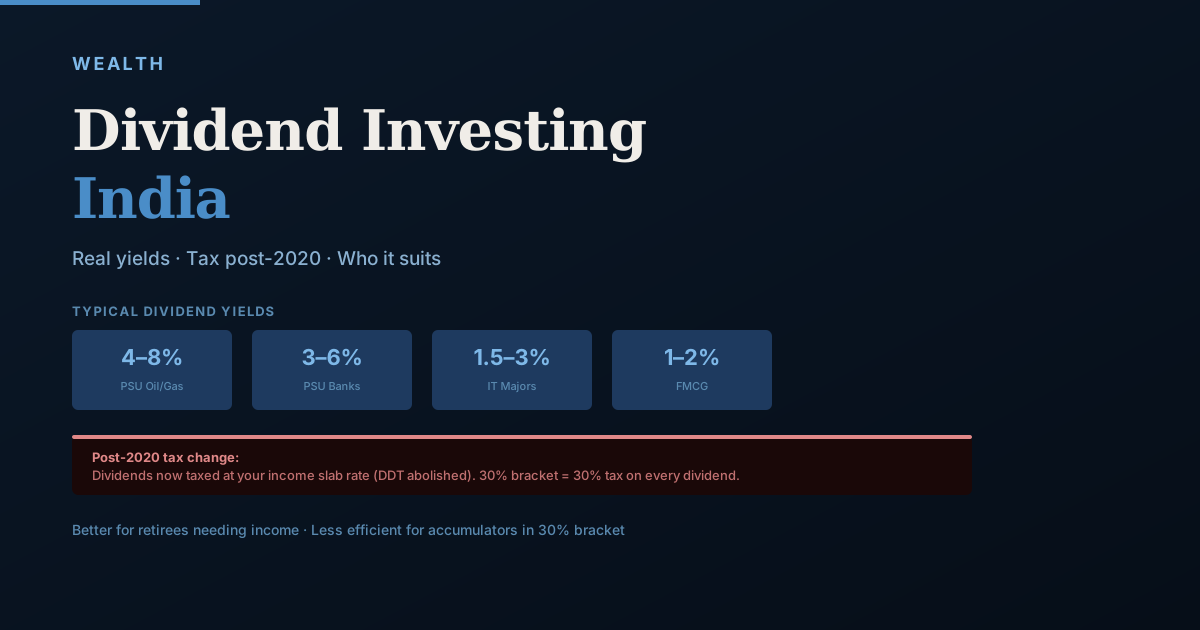
Dividend investing — building a portfolio of stocks that pay regular cash distributions — is a popular income strategy worldwide. In the Indian context, however, the mathematics and tax treatment require a clear-eyed look before committing to this approach.
What dividend yields actually look like in India
Dividend yield = Annual dividend per share / Current share price
Most high-quality Indian companies — large-cap IT, consumer goods, private banks — reinvest earnings for growth rather than distributing large dividends. Their yields typically run 0.5–2%.
PSU companies (public sector undertakings) tend to pay higher dividends due to government requirements:
| Sector | Typical Yield Range |
|---|---|
| PSU banks (SBI, Bank of Baroda) | 3–6% |
| PSU oil & gas (ONGC, Coal India) | 4–8% |
| IT majors (TCS, Infosys) | 1.5–3% |
| Consumer FMCG | 1–2% |
| Private banks | 0.3–1% |
These ranges are illustrative and change with share price movements.
A 2–3% dividend yield from Indian equities is roughly comparable to a savings account — which underscores the point that dividends alone are rarely the primary return driver for Indian equity investors. Capital appreciation typically dominates.
The tax change that matters: DDT abolished in 2020
Until FY2019-20, companies paid Dividend Distribution Tax (DDT) of approximately 20% before distributing dividends to shareholders. This meant dividends arrived tax-free in investor hands.
From FY2020-21 onward, DDT was abolished. Dividends are now added to your total income and taxed at your applicable slab rate. If you are in the 30% bracket, you pay 30% tax on every rupee of dividend received.
This change materially altered the dividend investing calculus for higher-income investors. A stock yielding 4% pre-tax now yields 2.8% post-tax for a 30% taxpayer — similar to a liquid fund but without the liquidity and with much higher volatility.
Dividend investing vs total return approach
Dividend investing focuses on income — receiving regular cash payouts from holdings. This is useful if you need a regular cash flow from your portfolio (e.g., in retirement).
Total return investing does not prioritise dividends. It focuses on overall portfolio growth — appreciation + dividends combined. When income is needed, a portion of the portfolio is sold periodically.
For Indian investors in the accumulation phase (building wealth, not yet in retirement), the total return approach is generally more tax-efficient:
- In a dividend portfolio, every dividend triggers a taxable event whether you need the cash or not
- In a growth-oriented portfolio, capital gains are deferred until you sell — and long-term capital gains above ₹1.25 lakh per year are taxed at 12.5%
The compounding advantage of deferred taxation is significant over a 20-year period.
Who dividend investing suits
Dividend investing makes more sense for:
- Retirees and near-retirees who need regular income from their portfolio without needing to actively manage sell decisions
- Investors in lower tax brackets (15–20%) where the tax impact on dividends is smaller
- Conservative equity investors who want companies with the financial discipline to pay regular dividends (often correlated with lower-volatility, mature businesses)
- Supplemental income seekers who want some cash flow from their portfolio alongside growth investments
It makes less sense for:
- Investors in the 30% bracket who do not need current income
- Young investors in the accumulation phase who benefit more from tax-deferred compounding
- Anyone who confuses high dividend yield with investment quality (a 9% yield on a deteriorating business is not attractive)
Dividend stocks vs dividend funds
Rather than picking individual dividend stocks, dividend yield mutual funds offer diversification across many dividend-paying companies. The fund manager selects stocks based on consistent dividend history and yield criteria. Distributions are periodic and taxable.
If dividend income is a goal, a fund approach reduces the risk of concentrated exposure to 3–5 companies and eliminates the need to track individual dividend announcements and reinvestment decisions.
The dividend trap: high yield is not always good news
One of the most common mistakes in dividend investing is chasing yield. A stock yielding 10% sounds attractive until you examine why — often it is because the share price has fallen sharply, mechanically inflating the yield. Dividend yield = dividend / price, so a falling price lifts the ratio.
Warning signs that a high yield may be unsustainable:
- The payout ratio (dividends as a % of earnings) is above 80–90% — the company is paying out almost everything it earns, leaving nothing to reinvest or cushion a bad year.
- Revenue or profits are declining while dividends remain flat — the company is maintaining a dividend it may not be able to afford.
- High debt alongside high dividends — borrowed money funding distributions is not a healthy business.
- PSU companies with unusually high yields may be responding to government pressure to pay dividends regardless of business conditions.
A dividend cut or suspension is typically followed by a sharp share price decline, which is precisely the wrong outcome for an income investor counting on that cash flow.
How dividend reinvestment works — and where it breaks down
Many brokers and direct-stock-plan schemes allow dividend reinvestment (DRIP): instead of receiving cash, dividends buy additional shares automatically. Over long periods, this can enhance compounding significantly.
The problem in India is taxation: even reinvested dividends are taxed at slab rate in the year received. You receive no cash but still have a tax liability on the dividend amount. This makes automatic reinvestment less attractive than it might appear — especially for 30% taxpayers — compared to simply investing in growth mutual funds (IDCW-free), where gains are only taxed on actual sale.
Building a dividend portfolio: practical framework
If dividend income is genuinely right for your situation, here is a systematic approach:
Step 1 — Screen for dividend consistency, not yield. Look at 7–10 year dividend payment history. Companies that have increased or maintained dividends across business cycles (including 2008, 2020) are more reliable than recent high-payers.
Step 2 — Check the payout ratio. For non-PSU companies, a 30–50% payout ratio is generally sustainable. Above 70% is a warning sign unless the business model generates unusually steady, predictable cash flows (utilities, for example).
Step 3 — Diversify across sectors. Concentrated exposure to PSU dividends (which look attractive on yield) carries regulatory and government-policy risk. A mix of IT, consumer, pharma, and infrastructure smooths the income stream.
Step 4 — Model the after-tax yield. At 30% tax, a 4% gross yield delivers 2.8% net. At 0% (basic exemption), it delivers 4%. Know your real post-tax return before comparing to alternatives.
Step 5 — Decide on funds vs direct stocks. Direct stock picking requires ongoing monitoring of earnings and payout sustainability. Dividend yield funds automate this but add an expense ratio (0.5–1.5%) that reduces your effective yield further.
Sovereign bonds and REITs as dividend alternatives
Two instruments offer more predictable income than dividend stocks and deserve comparison:
Government securities and RBI Floating Rate Savings Bonds (FRSB): FRSB 2020 currently pays 8.05% (reviewed semi-annually), fully guaranteed, backed by the Government of India. Taxable at slab rate, but the yield is fixed and the default risk is effectively zero. For income-oriented investors, this compares very favourably to the 2–4% most dividend stocks yield on an after-tax basis.
REITs (Real Estate Investment Trusts): Embassy Office Parks, Mindspace, Brookfield, Nexus Select all trade on Indian exchanges. REITs are required by law to distribute at least 90% of net distributable cash flows — delivering yields of 6–9% at recent prices, partly as dividends, partly as interest, and partly as return of capital (each taxed differently). REITs give real estate exposure with liquid, exchange-traded dividends.
Neither is a replacement for equity. But as part of an income-oriented portfolio, they offer more reliable, better-yielding income than most Indian dividend stocks without requiring individual stock selection.
The honest conclusion: dividends are a feature, not a strategy
For most Indian investors in their 30s to 50s still accumulating wealth, dividends are best treated as a by-product of owning quality companies — not a primary objective. The post-2020 tax treatment, the dominance of capital appreciation in Indian equity returns, and the availability of higher-yielding, lower-risk income instruments all tilt against building a portfolio around dividends.
The exception is a genuine income need: someone in retirement, or drawing partial income from a portfolio, for whom regular cash flows matter and the sell-to-spend discipline of total-return investing is difficult. In that case, dividend-paying stocks and funds, combined with FRSB and REITs, can provide a structured income layer.
The worst version of dividend investing is chasing yield numbers on a screener without understanding what the business does, whether the payout is sustainable, and what the after-tax income actually is.
Dividend income in retirement: a practical framework
For investors in or near retirement, dividend income can replace the "sell to spend" model — particularly if the regularity of income is psychologically important. A practical retirement-income portfolio combining dividends with other instruments might look like:
| Component | Allocation | Expected yield/return | Role |
|---|---|---|---|
| FRSB 2020 / RBI Bonds | 20–30% | 8% fixed | Sovereign-backed income floor |
| Debt mutual funds (short duration) | 15–20% | 7–8% | Liquid buffer, capital preservation |
| REITs | 10–15% | 7–9% distribution | Real estate income, listed liquidity |
| Dividend yield equity funds | 15–20% | 2–4% dividend + appreciation | Growth with partial income |
| Growth equity index funds | 20–30% | 11–13% total return | Long-term wealth preservation |
The key insight: dividends from equity should not be the primary income mechanism. They are supplemental and unreliable in lean years. The FRSB and short-duration debt funds provide the predictable floor; equity (dividend or otherwise) provides the growth that keeps the portfolio ahead of inflation.
TDS on dividends: what happens automatically
Since FY2020-21, companies are required to deduct TDS (Tax Deducted at Source) on dividends exceeding ₹10,000 in a financial year under Section 194 — a threshold raised from ₹5,000 with effect from 1 April 2025. The TDS rate is 10% (higher if PAN is not linked). This means:
- You receive dividend net of 10% TDS
- The TDS appears in your Form 26AS and AIS
- At the time of ITR filing, you add the gross dividend to income, compute tax at your slab, and claim credit for the TDS already deducted
- If your estimated total income for the year falls below the basic exemption limit — ₹4 lakh under the new regime, ₹2.5 lakh under the old — a resident under 60 can submit Form 15G to the company or registrar to stop the deduction (those aged 60 and above use Form 15H)
For mutual fund dividend distributions, the fund house deducts 10% TDS on distributions above ₹10,000 per year under Section 194K, which moved off ₹5,000 on the same 1 April 2025 date. This applies to both equity and debt fund IDCW (Income Distribution cum Capital Withdrawal) plans.
Building a dividend watchlist: criteria that matter
If you choose to track dividend-paying stocks directly, filter by these criteria rather than by yield alone:
-
Dividend payment track record: Consistent payment for 7–10 consecutive years, including through COVID-19 (FY2020-21) and the 2008 global financial crisis. Companies that maintained or grew dividends through downturns demonstrate genuine financial resilience.
-
Free cash flow (FCF) coverage: Dividends should be covered by free cash flow, not just accounting profits. A company with ₹10/share EPS but ₹2/share FCF paying ₹5/share dividend is borrowing to pay you.
-
Dividend payout trend: Is the payout per share growing over time? Flat dividends over 5 years while inflation runs at 6% means real purchasing power is declining. Growing dividends indicate a business that is genuinely improving its ability to return cash.
-
Promoter vs institutional ownership: Companies with high promoter ownership and a history of regular dividends tend to use dividends as a genuine mechanism to return value. Watch for promoter pledging — high promoter pledge is often a sign of financial stress incompatible with sustainable dividends.
-
Sector stability: Utilities (power, water), consumer staples (FMCG), and mature IT services companies tend to have more predictable dividends than cyclicals (metals, auto, chemicals) whose earnings — and dividends — swing with commodity prices and economic cycles.
These are evaluation criteria for judging a stock, not a recommendation to buy any specific company. Verify FCF, payout history and pledge data directly from the company's latest filings on the BSE/NSE or its annual report before acting, and for individual stock-picking at any real scale, a SEBI-registered investment adviser can pressure-test the analysis in a way a checklist alone cannot.
Frequently Asked Questions
Sources and references
- Income Tax Department, Government of India
- Memorandum to the Finance Bill 2025 — TDS threshold rationalisation (Sections 194 and 194K, ₹5,000 to ₹10,000 w.e.f. 1 April 2025)
- Reserve Bank of India (RBI)
- Association of Mutual Funds in India (AMFI)
Rules, rates, and thresholds in India change over time. Always confirm the current position with the official source above before acting on it.