Current Account for Your Business: What It Is, When You Need One, and How to Choose
A current account is the foundation of business banking in India. Learn how it differs from savings, when to open one, and what features to seek.
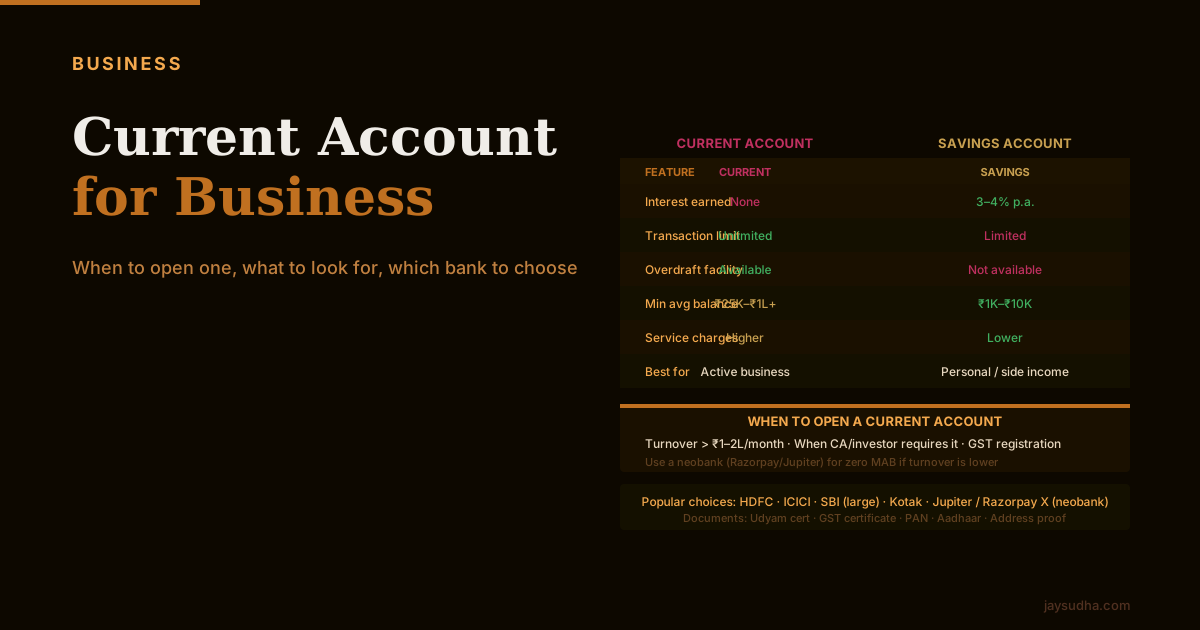
A current account is not simply a bank account for businesses — it's the infrastructure layer of business banking. It determines how you receive client payments, pay suppliers, manage payroll, handle GST payments, and interact with the broader financial system.
Getting the right current account from the start prevents the friction and complications that come from using the wrong type of account or the wrong bank for your business needs.
Current Account vs Savings Account: The Key Differences
| Feature | Savings Account | Current Account |
|---|---|---|
| Interest on balance | Yes (2.5–4% typically) | No |
| Transaction limits | Yes (usually restricted credits) | No — unlimited transactions |
| Minimum balance | Generally lower | Usually higher |
| Overdraft facility | Not available | Available (against collateral or business credit) |
| Designed for | Personal saving and spending | Business operations |
| Chequebook | Limited or basic | Full cheque book, MICR |
| Cash deposit charges | Often limited free cash deposits | Higher free cash deposit limits |
The main functional advantages of a current account for business:
- No transaction limits (critical when processing multiple client payments or supplier payments monthly)
- Overdraft against receivables — draw more than your balance when approved by the bank
- Structured for high-value, high-frequency transactions
- Suitable for receiving bulk payments (RTGS, NEFT, IMPS at scale)
When to Open a Current Account
Open a current account immediately if:
- You're registering a Pvt Ltd company or LLP (mandatory — the entity must have its own account)
- You're GST registered and expect regular inflow and outflow of tax amounts
- You have more than 5–10 business transactions per month
- You're applying for a business loan (lenders will need to see business bank statements)
- You have employees or subcontractors to pay regularly
- You want to use payment gateway services (Razorpay, PayU, Cashfree — they typically require a current account)
You can manage with a savings account if:
- You're just starting out as a sole proprietor with occasional client payments
- Your monthly transaction volume is very low (2–3 clients, simple payment structure)
The shift should happen the moment the business has regular, multiple transactions. Don't wait until it becomes a problem.
Features to Look For
Not all current accounts are the same. The features that matter for most small businesses:
Cash deposit limits: If you receive significant cash (retail, food businesses), look for accounts with high free cash deposit limits per month. Most banks allow a certain free limit (e.g., 5–10 times the monthly balance in cash deposits) before charging.
Cheque facility: A full cheque book with MICR (Magnetic Ink Character Recognition) cheques is needed for certain vendor payments, advance tax via cheque, and government payments.
Online banking and API access: The more sophisticated your operations, the more you benefit from internet banking with bulk payment capabilities, statement downloads in multiple formats, and API access for accounting software integration.
Debit card for business: A business debit card for everyday vendor payments and online purchases.
Payment gateway compatibility: If you plan to accept payments online, confirm the account is accepted by Razorpay, Instamojo, PayU, or your payment processor of choice.
Overdraft facility: Useful for managing short-term cash flow gaps. Available as secured (against FD or property) or unsecured (based on business creditworthiness).
Salary payment features: Net banking with bulk salary transfer capability (NEFT to multiple accounts in one transaction) if you have employees.
Minimum balance requirement: Choose a minimum balance you can sustainably maintain. Failing to maintain minimum balance results in penalties and a mark on your banking record.
Branch access: If your business involves frequent cash transactions or you need branch banking, proximity and branch hours matter. NBFCs and fintech accounts may be better on fees but worse on physical access.
Banks to Consider for Indian Small Businesses
Public Sector Banks (SBI, PNB, Bank of Baroda, Canara Bank):
- Pros: Lower minimum balance, MSME loan access, credibility with government tenders, wide branch network
- Cons: Slower digital interface, longer queue times, less responsive customer service
- Best for: Businesses dealing with government departments, those seeking PSU bank MSME loans, businesses in smaller cities or towns with good branch access
HDFC Bank:
- Smart Business Account with tiered features
- Strong digital banking, fast NEFT/RTGS processing
- Good integration with payment gateways
- Customer service considered best in class among private banks
- Higher minimum balance requirements (₹25,000–1,00,000)
ICICI Bank:
- Business banking with good digital access
- Widely accepted by lenders and investors (important if you plan to raise funding)
- Payment gateway and startup-friendly features
Axis Bank:
- Competitive current account offerings for SMEs
- Edge above average on digital banking
Kotak Mahindra Bank:
- Strong retail-commercial banking integration
- Good for businesses where the owner also has a Kotak savings account
IDFC First Bank:
- Often better rates on overdraft products
- Good digital interface
Yes Bank:
- Competitive for transaction-heavy businesses
Small Finance Banks (AU, Equitas, Ujjivan):
- Suitable for smaller businesses, often more flexible minimum balance
- May have limitations on large ticket transactions
Neobank Options (RazorpayX, Open Business Account, Signzy via ICICI/SBI):
- Best in class for digital-first, tech-comfortable businesses
- Zero or minimal balance requirements
- Excellent API integration with accounting software (Zoho Books, QuickBooks)
- No physical branches — all digital
- Not suitable if you need branch banking or have significant cash transactions
Opening a Current Account: Documents Required
For a sole proprietorship:
- PAN card (individual)
- Aadhaar card
- Address proof of business
- GST registration certificate or Udyam registration (at least one business proof)
- Photographs
- Introductory letter from an existing account holder (some banks)
For a Pvt Ltd company:
- PAN card of the company
- Certificate of Incorporation (from MCA)
- Memorandum and Articles of Association
- Board resolution authorising opening of the account
- PAN and KYC of all directors
- Registered address proof of the company
For an LLP:
- PAN card of the LLP
- Certificate of Incorporation
- LLP Agreement
- PAN and KYC of designated partners
- Address proof
The account opening process at most private banks is now entirely or mostly digital for proprietorships and can be completed within 1–3 working days.
Practical Setup After Opening
Once the account is open:
- Update your invoice template with the new business account details (bank name, account number, IFSC code)
- Set up payroll if you have employees — enter their account details for monthly salary transfers
- Notify all existing clients to use the business account for future payments
- Link to payment gateway if you accept online payments
- Set up net banking alerts — SMS and email notifications for every credit and debit
- Inform your CA — they'll need the account number for financial statements and filing
The current account is not just a compliance step — it's the operational hub of your business finances. Choosing the right bank and account type from the start avoids a painful migration later when your volumes and needs have grown.
Current Account and GST Compliance
Your current account is where your GST flows through, and keeping these transactions traceable matters both for your compliance and for any future audit:
GST collected from clients: When you raise an invoice for Rs.1,00,000 + 18% GST (Rs.18,000), the full Rs.1,18,000 should come into your business account (minus TDS if applicable). The Rs.18,000 is not your income — it's a liability to the government. Many freelancers make the mistake of treating total inflows as income, which leads to over-spending and a cash crunch when GSTR-3B payment is due.
GST paid on business purchases: When you pay for a software subscription, coworking space, or professional service and pay GST on it, that GST is ITC (Input Tax Credit) you can reclaim. Your bank statement shows the total amount paid — your accounting must separately track the GST component to claim ITC correctly.
GSTR-3B payment: Around the 20th of each month, your GST liability (output tax minus ITC) goes out from your account as a NEFT to the government's GST collection account. This is a predictable, recurring outflow that your cash flow planning must account for.
A clean current account where all these transactions are clearly visible simplifies your CA's work during GST filing and annual accounts preparation — typically reducing your compliance cost.
Current Account for Advance Tax Payments
Four times a year (or once if you use 44ADA presumptive taxation — consolidated into Section 58 under the Income-tax Act, 2025, effective 1 April 2026, with the same rate), you pay advance tax via Challan 280 from your bank account. The mechanics:
- Log in to incometax.gov.in
- Navigate to e-Pay Tax
- Select the correct assessment year and advance tax option
- The NEFT transfer goes from your current account to the government
The bank statement shows this as a debit to "NEFT - TIN-NSDL" or similar. Your accountant uses this to verify advance tax payments when preparing your ITR. Having all these transactions in a dedicated current account (not mixed with personal) means the advance tax payment trail is clean and unambiguous.
Set aside advance tax amounts in a separate sub-account or liquid fund to avoid accidentally spending the money between quarterly deadlines. Many current accounts offer sweep facilities — any balance above a threshold automatically moves to a short-term FD and breaks back instantly when needed.
Managing Multiple Business Revenue Streams
If your business has multiple revenue types (consulting + a physical product + online course), consider whether a single current account is sufficient or whether sub-accounts or multiple accounts help:
Single current account: Simplest setup. All income into one account, all expenses out. Use accounting software categories to separate revenue and expense types. Works well for most small businesses.
Multiple current accounts: Useful when different business lines have completely different compliance obligations (GST-registered consulting vs non-GST product sales), or when clients of one stream need to see different bank details from another.
Virtual accounts: Some banks and payment processors (RazorpayX, Open) offer virtual account numbers — each client can have a unique virtual account number that routes to your main account. Useful for reconciling which client payment corresponds to which invoice without confusion.
What Banks See in Your Account That Affects Lending
Your current account's transaction history is the first thing any lender examines when you apply for a business loan:
Average monthly balance: Not the closing balance on any single day, but the average across the month. A higher average balance signals business health. Banks look at 12-24 months of average monthly balance data when assessing your creditworthiness.
Turnover consistency: Monthly credit totals that are stable or growing are a positive signal. Highly erratic income (Rs.50 lakh in one month, Rs.2 lakh the next) requires explanation and may reduce confidence in projections.
Absence of returned instruments: A bounced cheque or failed NACH debit creates a negative record. Banks track these internally even when they don't appear on your formal credit report.
Inward TDS credits: For professional services businesses, regular TDS credits (typically under "TDS by [Company Name]") signal that you have established corporate clients — a positive creditworthiness indicator.
Cash deposits: Significant cash deposits relative to digital receipts can raise questions. Banks are required to report cash deposits above Rs.10 lakh in a financial year to the income tax department under SFT (Specified Financial Transaction) reporting.
Maintaining your current account as if a lender is always watching — because they will be, the day you need credit — builds a track record that makes future borrowing easier and cheaper.
Current Account Minimum Balance: Practical Management
Failing to maintain minimum balance in a current account results in two costs: the quarterly or monthly penalty charge, and a small but real negative mark on your banking record. Practical approaches:
Match your account tier to your business stage: Don't open a premium current account (Rs.1 lakh minimum balance) when your business is at Rs.5-10 lakh annual revenue. The minimum balance requirement should be achievable comfortably. Start with a basic current account, upgrade when your average monthly balance naturally exceeds the higher tier's minimum.
Sweep facility: If your bank offers a sweep-in facility on the current account, activate it. Balance above the minimum automatically moves to an FD (earning interest) and sweeps back in when needed. This makes the minimum balance work for you rather than sitting idle.
Alert setup: Set a low-balance alert at 150% of the minimum balance requirement. This gives you a warning buffer to top up the account before falling below the minimum — avoiding the penalty.
Bank fee structures and minimum-balance rules change without much notice — confirm the current terms with the bank directly before choosing an account on the numbers in this guide alone.
Frequently Asked Questions
Sources and references
- Goods and Services Tax — Official GST Portal, Government of India
- Income Tax Department, Government of India
- Income Tax Department — Income-tax Act, 2025 (FAQs on Interplay and Transition, and Act text)
Rules, rates, and thresholds in India change over time. Always confirm the current position with the official source above before acting on it.