Credit Score Improvement Plan: A Step-by-Step Guide
Improving your credit score is straightforward once you understand what it's built from. No tricks — just fixing what's dragging it down.
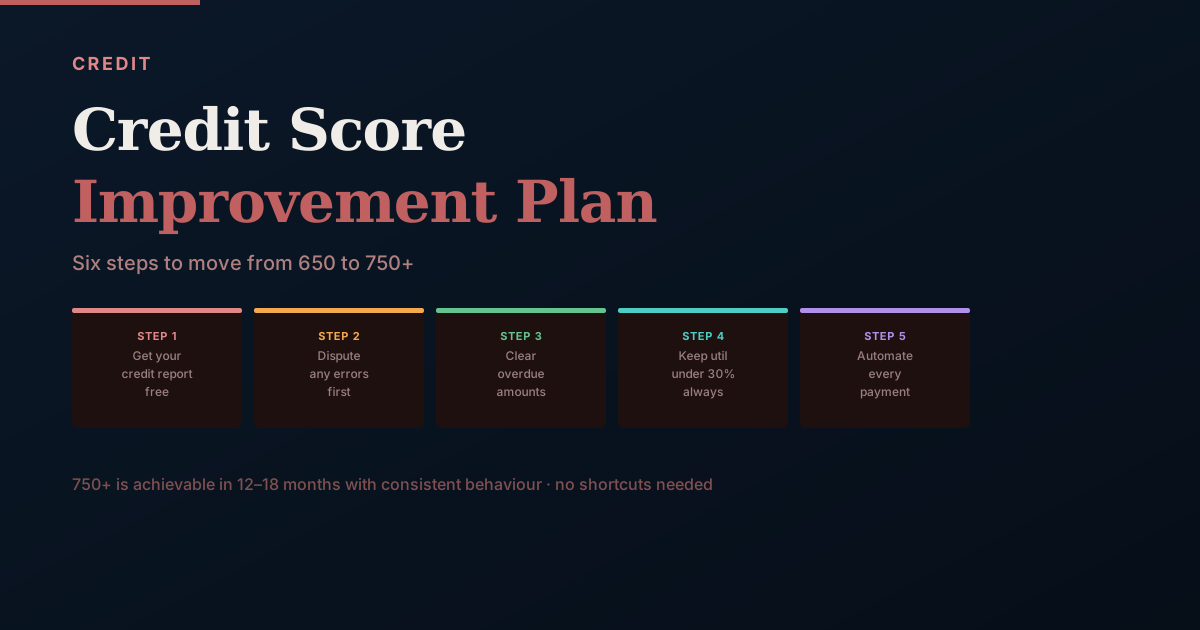
Your credit score is a number built from your borrowing history, and it can be improved systematically. The challenge is that most people focus on symptoms (the number) rather than the underlying behaviours that produce it.
What a Credit Score Measures (In India)
Indian credit bureaus — CIBIL, Experian, Equifax, CRIF — generate scores typically between 300 and 900. Lenders predominantly use CIBIL.
The CIBIL score is weighted roughly as follows:
| Factor | Weight | What Hurts It |
|---|---|---|
| Payment history | ~35% | Any missed or late payment |
| Credit utilisation | ~30% | Using >30% of credit limit |
| Credit age | ~15% | New accounts, closing old ones |
| Credit mix | ~10% | Only one type of credit |
| New credit enquiries | ~10% | Multiple loan applications |
Step 1: Get Your Report and Identify the Damage
Before improving, you need to know what's dragging your score.
- Get your free report from CIBIL (once/year free; paid for more) or use Paisabazaar, BankBazaar, or OneScore for free Experian checks
- Review every account: open, closed, settled, written-off
- Look for: missed payments, high utilisation, incorrect data, accounts you don't recognise
Common items that drag scores:
- "Settled" status (worse than paid in full — indicates negotiated debt)
- "Written off" accounts
- Incorrect DPD (Days Past Due) figures
- Loans you co-signed or guaranteed for someone else
- Enquiries you didn't initiate (fraud risk)
Step 2: Dispute Errors First
If anything in your report is factually incorrect:
- File a dispute on the bureau's website (CIBIL, Experian, etc.)
- Provide documentary evidence (payment receipts, NOC from lender, etc.)
- Bureau has 30 days to investigate and respond
Credit report errors are more common than people expect — wrong DPD figures, duplicate accounts, accounts from identity fraud. Clean these up before anything else, because no amount of good behaviour overcomes incorrect negative records.
Step 3: Clear Any Outstanding Dues
The fastest score improvement comes from clearing overdue amounts. Even a ₹500 outstanding credit card payment that went unnoticed drags your score significantly.
Priority order:
- Clear any accounts marked "Past Due" or "Overdue"
- Get a No-Objection Certificate (NOC) from the lender after clearing
- Ask the lender to update the bureau with correct "closed" or "paid" status
- Confirm the update appears on your report in 45–60 days
Step 4: Reduce Credit Utilisation
Credit utilisation = (total balance across all cards) ÷ (total credit limit across all cards) × 100
Above 30% utilisation begins hurting your score. Above 50% hurts significantly.
Strategies to reduce utilisation:
- Pay off card balances before the statement date (not just the due date)
- Pay in multiple instalments during the month if you're a heavy card user
- Request a credit limit increase on existing cards (improves the ratio without spending more)
- Don't close unused cards unless they carry fees (keeps total limit higher)
Step 5: Never Miss a Payment — Going Forward
Payment history is the largest component. One missed EMI at a 30-day DPD (30 days past due) can drop your score 40–80 points.
Automate every payment:
- Set up NACH/autopay for every EMI
- Set up auto-pay for at least the minimum due on every credit card
- Set calendar reminders 5 days before every due date as a backup
Missing a payment accidentally is usually fixable; making it a pattern is not.
Step 6: Manage New Credit Applications
Each time you apply for credit, the lender does a "hard pull" that leaves an enquiry on your report. Multiple enquiries in a short period signals financial stress to lenders and knocks points off.
- Apply for new credit only when genuinely needed
- Don't apply to 4 banks simultaneously to "compare" — they all pull your report
- If you're shopping for a home loan, do it within a 30-day window (many bureaus treat multiple enquiries of the same type within 30 days as a single enquiry)
Realistic Timeline
| Score Range | Likely Cause | Time to 750+ |
|---|---|---|
| 750–900 | Strong history | Maintenance only |
| 700–749 | Minor issues, high utilisation | 3–6 months |
| 650–699 | Missed payments, moderate issues | 9–15 months |
| 600–649 | Significant misses, settled accounts | 12–24 months |
| Below 600 | Defaults, write-offs | 24–36 months minimum |
There is no shortcut. Advisers who claim to "fix" your score in weeks using paid services are offering the same actions you can take yourself for free.
Building a Credit Score from Scratch (Thin File)
If your score shows as "NH" (No History) or "NA" (Not Applicable) on the CIBIL report, you haven't scored in the range yet — you simply don't have enough credit history for the scoring model to produce a number.
Lenders typically treat NH/NA scores as equivalent to a low score, because there is no behavioural data to evaluate. Here's how to build a file:
Secured credit card against FD: Apply for a credit card backed by a fixed deposit. HDFC Bank (MoneyBack/Regalia FD card), SBI (against FD), Axis Bank, Kotak Mahindra Bank, ICICI Bank, and IndusInd Bank all offer this. The FD amount is typically ₹10,000–₹25,000 to start. The credit limit is usually 80–90% of the FD. Use the card for one or two small recurring expenses — a utility bill, a streaming subscription. Pay the full balance before the statement close date each month. After 6 months of activity, you will start generating a score. After 12 months, you should have a usable score in the 650–700+ range if there are no missed payments.
Consumer durable loan: Some banks and NBFCs extend small consumer durable loans (for a phone, appliance, or laptop) to borrowers with no credit history as an entry point. Repaying the loan perfectly adds an instalment credit account to your history, which also improves credit mix later.
Being added as authorised user: If a family member with good credit adds you as an authorised user on their credit card, some (though not all) bureaus may factor in that card's history. The effect is inconsistent and should be treated as supplementary, not primary.
The minimum for CIBIL to generate a score is typically 6 months of credit history with at least one active account.
What "Settled" Status Means and How to Address It
One of the most damaging entries on an Indian credit report is the "Settled" status. This occurs when a borrower who cannot repay the full outstanding negotiates a one-time settlement with the lender — paying a reduced amount in full and final satisfaction. The lender accepts less than what is owed to close the case.
CIBIL marks this account as "Settled" — which is significantly worse than "Closed" (full repayment). The implications:
- Most lenders view "Settled" accounts as evidence of a credit event
- The account typically stays on the report for several years
- Future loan approvals, especially home loans, become difficult
If you have a settled account: The only way to improve its impact is:
- Check whether the settlement amount was actually paid correctly (occasionally records show incorrect settlement status)
- Get a No-Dues Certificate from the lender confirming the settlement
- Some lenders will agree to re-mark a settlement as "Closed" if you pay the remaining amount that was waived — contact the lender directly to discuss
- If neither is possible, allow clean payment history on all other accounts to build a track record over 24–36 months that contextually offsets the settlement entry
Protecting Your Score During Major Life Events
Several life transitions create specific credit risks that most people don't anticipate:
Job change: NACH/auto-pay mandates are linked to your old bank account's salary credits. If salary moves to a new account and the old account becomes low on funds, auto-pay mandates may fail — causing late payment marks on loans and credit cards. Update auto-pay details immediately when changing salary accounts.
Divorce or separation: Joint loan accounts (home loan taken jointly with a spouse) continue to report to both individuals' credit files regardless of relationship status. A divorce decree does not automatically transfer loan liability. The loan must be formally refinanced in one person's name to separate the credit obligation.
Relocation abroad: Indians working abroad sometimes neglect Indian credit card bills or loan EMIs, assuming these will resolve themselves. They don't — missed payments continue to accumulate on the India credit report. Maintain an active Indian bank account with sufficient balance on auto-pay before relocating.
Medical emergency: If an emergency depletes savings and causes EMI misses, contact lenders proactively rather than waiting for the account to go delinquent. Banks can offer moratoriums (temporary payment pauses) and loan restructuring for genuine hardship cases. The option is easier to access before the account has missed payments than after.
Monitoring Progress: Free and Paid Options
Free options:
- CIBIL: mycibil.com — one free report per year (no score included free, but score is shown if you log in to a MyMyCIBIL account)
- Experian: experian.in — free report includes score
- OneScore, Paisabazaar, BankBazaar, CRED — these platforms offer free Experian or CRIF-based score tracking using a soft inquiry, with no impact on the score
Paid monitoring:
- CIBIL's paid subscription (₹550–₹1,200/year) gives monthly score updates and alerts for new inquiries or account changes — useful during active credit rebuilding or before a major loan application
A practical monitoring routine: check a free soft-inquiry score via Paisabazaar or OneScore monthly to track direction. Pull the full bureau report from the official bureau website once per quarter (staggered across bureaus). Use paid monitoring only if you're in active recovery mode or suspect ongoing fraud.
What Lenders Actually See: The Full Underwriting Picture
Your CIBIL score is the automated first filter. But when a lender's credit officer reviews your full file, they see considerably more nuance than the score reflects.
Recent inquiries pattern: If your report shows 6 hard inquiries in the past 3 months, this signals credit-seeking behaviour — even if each inquiry only knocked 5 points off the score. The officer may ask about this. A legitimate answer (you were rate-shopping for a home loan) is different from a pattern of serial applications for personal loans.
Account status history: The officer reads the DPD table for each account. A score of 720 achieved after recovering from a default 18 months ago looks different from a 720 that was built steadily from a thin file. The history provides context the score cannot.
Settled accounts: Even if your current score is 730, a "settled" entry from 3 years ago on a personal loan will be visible and can cause a lender to ask for additional justification or decline outright. The score does not hide the settled status — it is visible in the report.
High outstanding balances on multiple accounts: Even if all payments are current, a report showing ₹12 lakh outstanding across a car loan, personal loan, and credit cards will generate FOIR concerns independently of the score.
This is why score improvement and report management must go together. A good score with a concerning report history will face friction at underwriting. A genuinely clean report — correct data, no negative entries, low outstanding, consistent payments — will sail through.
The 12-Month Improvement Checklist
For someone starting at a score of 650–690 and targeting 750+ in 12 months, here is a practical monthly checklist:
Months 1–2:
- Pull reports from all four bureaus
- Identify and file disputes for any factual errors
- Clear all overdue amounts and obtain NOCs
- Set up NACH auto-pay for minimum due on all credit cards and full EMI on all loans
Months 3–4:
- Pay down highest-utilisation card to below 30%
- If you have a closed account still showing as open, follow up on the dispute filed in month 1
- Avoid any new loan applications or credit card applications
Months 5–8:
- Continue paying all accounts on time — no exceptions
- If utilisation is now below 30%, target getting it below 10% on the highest-limit card
- Check score monthly via a soft-inquiry platform to confirm upward direction
Months 9–12:
- If a secured credit card was opened to build history, the card is now eligible for higher spend — keep utilisation below 10% and pay in full
- Confirm dispute corrections are reflected in all bureau reports
- If planning a loan application at month 12, pull the specific bureau your target lender uses and verify it reflects your improved position
Most people who follow this checklist diligently see 60–90 point improvements within 12 months from a 650–680 starting point. The ceiling after 12 months is typically 740–760 — reaching 780+ requires a further 12–18 months of sustained clean history.
Putting this into practice
A real example
A score is stuck at 710 with two issues: a card running at 80% utilisation, and a four-year-old loan still showing as "settled." Paying the card down to 25% and disputing the settlement status (if it was wrongly marked) can move the score toward 760+ over three to six months. There is no overnight version of this.
A common mistake
Closing old cards to "clean things up" — which shortens your credit age and pushes utilisation up on the cards that remain.
When this doesn't apply
If the cause is an error on your report rather than your own behaviour, the fix is a formal dispute through the bureau, not a change in how you spend. Changing spending won't correct a wrongly recorded default.
Jay's operating note: A credit score moves like a supertanker, not a speedboat. Anyone promising a 100-point jump in a week is selling something.
Your decision checklist
- Utilisation brought under 30%
- All EMIs and dues on autopay
- Report pulled and any errors formally disputed
- Old accounts kept open
- New applications paused for at least six months
- Re-check the score quarterly to confirm the trend
Review rhythm
- Monthly: confirm every card and EMI cleared on autopay, and keep utilisation under 30% before each statement date.
- Quarterly: pull your report, check the trend, and chase any dispute still showing unresolved.
- Annually: read the full report from each bureau for errors, wrongly held "settled" tags, and old entries that should have dropped off.
Frequently Asked Questions
Sources and references
Rules, rates, and thresholds in India change over time. Always confirm the current position with the official source above before acting on it.