Credit Card Debt Strategy: 6 Proven Steps to Clear Debt Without Panic
Credit card debt is dangerous, but a structured repayment plan clears it. Here is how to pay it off systematically and avoid falling back into it.
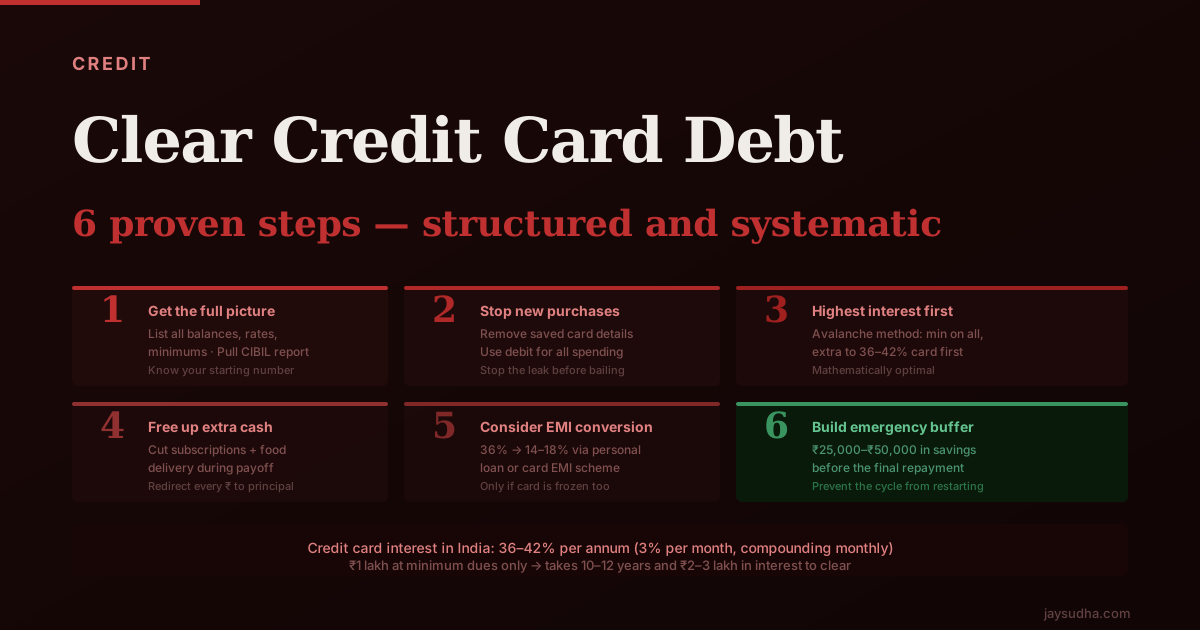
Credit card debt is the financial problem that sneaks up gradually. It rarely starts with a single irresponsible decision. It builds from a few months of spending more than planned, a job transition where expenses exceeded income temporarily, a medical emergency that was not fully covered by insurance, or simply a pattern of paying minimum dues without realizing how much interest was compounding.
However it started, the solution is the same: a structured, systematic approach to clearing it — and a permanent change to the habits that allowed it to grow.
This guide covers both.
Understanding why credit card debt grows faster than it feels
Before the strategy, the mechanics need to be clear. Credit card interest in India is not 36% on the unpaid amount from a lender's annual calculation — it is 3% per month, compounding monthly.
Let us trace a ₹1 lakh balance with minimum payments only:
- Month 1: ₹1,00,000 balance. Minimum due = ₹5,000 (5%). Interest charged = ₹3,000. After payment, balance = ₹98,000.
- Month 2: ₹98,000. Interest = ₹2,940. Minimum = ₹4,900. Balance = ₹96,040.
- Month 12: After one year of minimum payments, balance is approximately ₹78,500 — despite paying roughly ₹53,800 across the year.
You have paid ₹53,800 and the debt has reduced by only ₹21,500. The remaining ₹32,300 — about 60% of everything you paid — was consumed by interest.
At this rate, clearing a ₹1 lakh credit card balance with minimum payments alone takes approximately 12 years. Total payments over that period come to roughly ₹2.4 lakh — of which about ₹1.4 lakh is interest, more than the original balance itself. The numbers are illustrative and depend on exact interest rates and minimum payment amounts.
This is not a trap you need to understand academically. It is the situation you are actively in if you carry a balance and pay minimums.
Step 1: Get the complete picture of all outstanding debt
Before any repayment plan, know exactly what you owe across all credit accounts.
Pull your credit report (free at cibil.com and other bureau websites) to see every outstanding balance. List all credit accounts with:
- Outstanding balance
- Interest rate (APR or monthly rate)
- Minimum due amount
- Total credit limit
If you have multiple credit cards with balances, personal loans, and other consumer debt, this gives you the complete debt picture.
Most people with significant credit card debt are surprised by the total when they add it up. This number is not a judgment — it is the starting coordinate for the repayment plan. It is also worth checking your debt-to-income ratio at this stage, since it tells you how much of your income is already committed before you plan the extra repayment amount.
Before you can stop the debt from growing, it helps to understand what carrying credit card debt is doing to your credit score in India — high utilization is one of the fastest ways to drag it down.
Step 2: Stop all new credit card purchases immediately
You cannot effectively bail out a leaking boat while water is still flowing in.
During the entire credit card debt repayment period, stop adding new purchases to any card that carries an outstanding balance. This means:
- Remove saved card details from online shopping apps and websites
- Use a debit card for all discretionary purchases
- Pay for essentials (groceries, utilities) with UPI or debit
- Physically keep credit cards out of wallet if that helps
This is not a permanent lifestyle change. It is a temporary suspension of credit card spending until the balance is cleared. The credit card itself stays open (closing it would hurt your credit score and credit history length). You just do not use it for new charges.
Step 3: Prioritize the highest-interest debt first
If you have multiple credit card balances or a mix of credit card debt and other consumer loans, prioritize repayment by interest rate.
Avalanche method (mathematically optimal): Pay the minimum on all accounts, then direct all extra money toward the account with the highest interest rate. Once cleared, move to the next highest rate account.
Credit card debt at 36–42% should always be cleared before personal loans at 14–18%, which should be cleared before car loans at 9–12%, which should be cleared before home loans at 8.5–10%.
Snowball method (behaviorally effective for some): Pay the minimum on all accounts, then direct extra money toward the smallest balance first. The faster you close individual accounts, the more psychological momentum you feel. This produces slightly worse mathematics but often better follow-through for people who struggle with motivation on long repayment timelines.
Pick whichever method you will actually execute. The best debt repayment strategy is the one you stick to. Run your own numbers through the debt payoff calculator to see the actual months and interest at your balance, rate, and payment amount.
Step 4: Find extra repayment amount from your budget
The repayment plan requires you to pay more than the minimum due each month. Where does that extra amount come from?
Audit current subscriptions and recurring costs: Streaming services, club memberships, app subscriptions, gym memberships not being used. Suspending or cancelling these during the repayment phase releases cash flow for debt repayment.
Reduce dining out and food delivery: For most urban households, this is the largest controllable discretionary expense. A 60-day reduction in food delivery alone often frees ₹3,000–₹8,000 per month.
Suspend non-essential SIPs temporarily: This is a judgment call with trade-offs. Pausing a small equity SIP to accelerate clearing 36% interest debt is often mathematically justified — you are essentially getting a guaranteed 36% return by eliminating that debt. However, do not stop EPF or employer-matched contributions. Resume SIPs the moment the credit card debt is cleared.
One-time sources: Annual bonus, a tax refund, selling unused items. These should be applied directly to the highest-rate debt rather than added to general spending.
Step 5: Consider the EMI conversion as a bridge, not a solution
Credit card companies and banks often offer balance EMI conversion — converting your outstanding balance to a fixed EMI at a lower interest rate. Common options:
- Card's own EMI conversion: Most Indian credit cards allow converting outstanding balance to 3–24 month EMIs at 12–18% per annum. This is significantly better than the default 36–42% revolving credit rate.
- Personal loan to close credit card: A personal loan at 14–18% to fully clear a credit card balance reduces the effective interest rate and converts revolving debt to a fixed repayment schedule.
The benefit is real and worth considering if you cannot immediately direct large lump sums to clear the balance. See personal loan vs credit card for a fuller comparison of when each makes sense.
The critical condition: Converting to EMI only helps if you stop adding new charges to the card. Many people convert to EMI and then continue using the card, ending up with both an EMI payment and a new revolving balance. This makes the situation worse, not better.
If you use the EMI conversion route, pair it with the full spending freeze on that card.
Step 6: Build a small emergency fund before the final payment
One reason debt-free periods do not last is the absence of an emergency fund. When an unexpected expense arrives — a vehicle repair, a medical bill, a home appliance replacement — with no cash available, the credit card is the default solution. The debt cycle restarts.
Before clearing the last ₹20,000–₹30,000 of credit card debt, consider redirecting some repayment amount to build a ₹25,000–₹50,000 emergency buffer in a savings account — see how much emergency fund you actually need to size it properly. This slows the debt repayment by a few weeks but significantly reduces the probability of immediately reaccumulating debt.
The emergency fund and debt clearance can happen in parallel in the final phase. The goal is to be simultaneously debt-free and buffer-protected.
Once the debt is cleared, a clean monthly budget system is what prevents it from accumulating again — specifically the savings-first structure that caps discretionary spending before it reaches your card.
Preventing the cycle from repeating
Once credit card debt is cleared, the behavioral question is: what pattern led to the debt, and has it changed?
Most credit card debt in India comes from one of three patterns:
- Regular overspending — consistently spending more than monthly income
- Emergency reliance — using credit cards for genuine emergencies because no liquid buffer existed
- Minimum payment habit — using cards normally but paying only minimum due for months or years without noticing the accumulation
Each requires a different prevention strategy:
| Pattern | Prevention |
|---|---|
| Regular overspending | Monthly budget system with automatic savings-first allocation |
| Emergency reliance | Emergency fund of 3 months expenses in a liquid account |
| Minimum payment habit | Autopay set to full statement balance every month |
Credit cards are not inherently problematic financial tools. Used for planned purchases and cleared in full each month, they offer rewards, purchase protection, and cash flow flexibility. The problem is not the card — it is the pattern.
A credit card used well: spend within your budget, pay in full every statement cycle, never carry a balance. At that point, the card works for you. The moment a balance begins to carry and compound, it starts working against you.
Negotiating with Credit Card Companies in India
Indian credit card issuers, like banks globally, have internal hardship programs that most customers are unaware of. If you are in genuine financial distress and carrying a significant outstanding balance, it is worth attempting a direct negotiation.
Waiver of late payment fees and penalty interest: If you have a history of on-time payments followed by a period of financial difficulty, banks sometimes waive late payment charges and interest for a defined period if you make a request in writing and resume payments. This is not guaranteed but is available at the discretion of the bank's collections team.
Conversion to personal loan / EMI at lower rate: Most major Indian banks (HDFC, ICICI, SBI Card, Axis) have formal programs to convert outstanding credit card balances to personal loan EMIs at 12–18% per annum — significantly lower than the revolving rate. This conversion is available to customers who are still current (not yet in default). It requires calling the bank or submitting a request through netbanking. The benefit is substantial: converting ₹1 lakh outstanding from 36% to 15% halves the ongoing interest cost.
One-Time Settlement (OTS): For accounts that have gone significantly past due (90+ days overdue, NPA classification), banks may offer a one-time settlement for a negotiated amount less than the full outstanding. This is a last resort — the account is marked "settled" on the credit report for several years, which severely affects future borrowing. However, for a borrower who genuinely cannot repay the full amount, settling and moving forward is better than letting the account remain in NPA status indefinitely.
What banks generally will not do: Reduce the interest rate on an ongoing basis as a permanent arrangement, waive the principal, or stop reporting to credit bureaus. These are not standard options.
The CIBIL Impact Roadmap: What to Expect as You Clear Debt
Understanding how credit score changes during the debt payoff process helps set realistic expectations and maintain motivation.
Month 1–3 (active clearance begins):
- If you have any payments that were late, those DPDs are already recorded. Focus on making every payment on time from this point forward — the positive payment history starts building immediately.
- High utilisation continues to suppress the score. Score may stay flat or improve modestly as utilisation begins dropping.
Month 4–6 (debt declining significantly):
- As outstanding balances drop, utilisation decreases. Expect 10–25 point improvement from this factor alone.
- If the card's statement balance drops below 30% of the credit limit, a more significant improvement becomes visible.
Month 12 (debt cleared or near cleared):
- Utilisation at or near 0% on the cleared card provides a meaningful score boost.
- 12 months of on-time payments begins to meaningfully dilute the negative impact of any earlier late payments.
- If the score was around 650 pre-clearance, targeting 700–720 in 12 months is realistic.
Month 18–24 (sustained clean behaviour):
- Earlier late payment history is now 18–24 months old — its relative negative weight in the scoring model diminishes.
- A consistently paid-in-full card with low utilisation is now a strong positive asset in the score.
- Scores of 750+ become accessible for most borrowers who have cleared all outstanding and maintained clean behaviour.
The key insight: the score doesn't improve linearly. There is often a lag of 1–2 billing cycles after you change behaviour before the score reflects it, because the bureau reports the balance at statement close — not in real time.
Using Credit Cards Sustainably After Clearing Debt
Once the debt is cleared, the goal is to use credit cards as the financial tool they are meant to be — without falling back into the trap.
The full-payment rule as a non-negotiable: Set up auto-pay for the full statement balance on every card, not just the minimum due. This removes the temptation to carry even a small balance ("just this month").
Spending cap discipline: Some people find it useful to set a personal spending limit on their card that is lower than their credit limit — treating the credit limit as irrelevant and using only what they have cash to repay. This can be enforced by setting up alerts (available on most bank apps) when spending approaches the self-set limit.
Single card simplification: If you had multiple cards and overspending across them was part of the problem, consolidating to one card during the recovery phase can simplify tracking. Add a second card only after demonstrating 12 months of clean single-card behaviour, and set it up as a deliberate two-card structure rather than extra headroom to spend into.
Reward redemption as an indicator: If you are consistently extracting value from reward points (cashback, fuel surcharge waiver, vouchers), it is a useful signal that you are using the card correctly — you are spending normally and extracting the benefit, rather than accumulating points you never use because the full amount never gets paid.
Frequently Asked Questions
Sources and references
Rules, rates, and thresholds in India change over time. Always confirm the current position with the official source above before acting on it.