Client Contract Basics for Freelancers: What to Include
A simple written agreement protects both you and your client. These are the essential clauses every freelance contract should cover — in plain language.
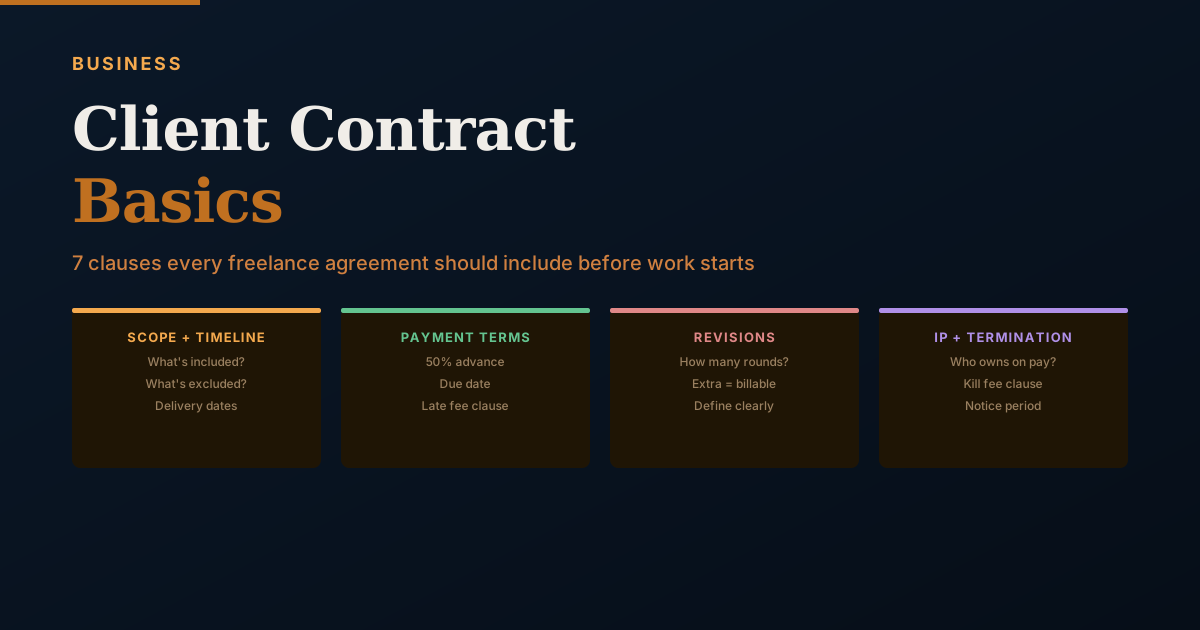
Most freelance disputes — scope creep, delayed payments, IP ownership — happen because there was no clear written agreement at the start. A short, clear contract prevents most of these problems.
The 7 Essential Clauses
1. Scope of Work
Describe exactly what you will deliver:
- What is included
- What is explicitly excluded
- Deliverable format (e.g., "3 landing page designs in Figma, exported as PNG and SVG")
- Milestone definitions if applicable
Vague scope = unlimited scope. Every "while you're at it" request costs you time.
2. Timeline
- Start date
- Delivery deadlines for each milestone
- What happens if the client delays providing materials (timeline extends accordingly)
3. Payment Terms
- Total amount or rate
- Payment schedule (50% advance, 50% on delivery; or milestone-based)
- Accepted payment methods
- Late payment interest or fees (optional but useful)
- What happens if payment is not received (work pauses)
4. Revision Policy
Define what's included:
- "Two rounds of revisions included; additional revisions billed at Rs.X/hour"
- What counts as a revision vs a scope change
Without this clause, clients may expect unlimited changes.
5. Intellectual Property
Two options:
- Client owns IP on payment: You transfer all rights to the client once payment is received in full
- You retain IP until payment: Usage rights transfer only after full payment
Also address: tools, fonts, stock images used — you cannot transfer rights to third-party assets you don't own.
6. Confidentiality (NDA)
Standard clause: you will not disclose the client's business information, strategies, or materials to third parties. Useful for most professional engagements.
7. Termination
- Either party can terminate with X days written notice
- What happens to work done so far (payment for completed milestones)
- What happens to deposits paid
A Simple Starting Template
Your contract doesn't need to be long. A 1-page document covering the above points is legally sufficient for most freelance engagements under Rs.5 lakh.
Format: either a Word/PDF document signed by both parties, or a tools like Docusign/Zoho Sign for digital signatures.
Frequently Missed Clauses
Kill fee: If the client cancels mid-project, they pay for work already done plus a percentage of the remaining project value.
Usage rights vs. ownership: Especially for creative work — clarify if the client gets unlimited usage rights or just the agreed deliverables.
Force majeure: What happens if either party can't perform due to circumstances outside their control.
Getting It Signed Without Friction
A contract shouldn't slow the deal down. Keep a reusable 1–2 page template and send it with the proposal, not after. Use a digital-signature tool (Zoho Sign, DocuSign) or even an explicit email confirmation — "Reply 'agreed' to confirm scope, ₹X, and 50/50 payment terms." The lighter the signing step, the less a genuine client resists it, and resistance itself is useful information.
The Advance Is Your Real Protection
The single most effective clause is the upfront deposit. A 30–50% advance:
- filters out clients who never intended to pay,
- funds the work so a delayed final payment doesn't trigger a cash crisis,
- and commits the client to the project.
State explicitly that the advance is non-refundable once work begins — it covers the time you've blocked out and the work you turned away.
If a Client Doesn't Pay
A contract matters most when payment fails. The escalation path in India:
- Reminder + statement of account, then a firmer email citing the agreed terms and any late-payment clause.
- Formal demand notice through a lawyer — often enough on its own; it signals seriousness and creates a record.
- MSME Samadhaan: if you've registered (free) under Udyam as a micro or small enterprise, you can file a delayed-payment complaint online. The MSMED Act entitles registered MSMEs to payment within 45 days plus compounded interest on delays — a strong, low-cost lever freelancers rarely use.
- Small claims or civil suit for larger sums. Your signed scope-and-payment document is the evidence that makes any of these work.
A Note on GST and Invoices
If you're GST-registered, state whether your fee is inclusive or exclusive of GST, and make sure your invoice carries your GSTIN, the SAC code, and the tax breakup. Ambiguity here — "was the ₹50,000 plus or including GST?" — is a common, entirely avoidable dispute.
GST and Tax Clauses Every Freelance Contract Should Address
Most freelance contracts in India neglect two financially important clauses: GST treatment and TDS handling. Both should be explicit in the contract to avoid disputes.
GST clause: State clearly whether your fee is exclusive of GST:
"The fees quoted above are exclusive of applicable Goods and Services Tax (GST). GST at the prevailing rate shall be charged separately on the invoice. If the Consultant's annual turnover crosses the mandatory registration threshold, the Client agrees to receive GST-compliant invoices and make payment for GST in addition to the agreed fee."
Or, if GST inclusive:
"The fee of Rs.X is inclusive of all applicable GST. No additional GST will be charged."
Ambiguity here — "was the Rs.50,000 plus or including GST?" — creates a Rs.9,000 disagreement that damages the client relationship. Be explicit.
TDS clause: Acknowledge the TDS deduction obligation clearly:
"The Client shall be responsible for deducting TDS at the applicable rate under Section 194J (or other applicable sections) of the Income Tax Act from payments made to the Consultant and depositing the same with the government. The Client shall provide Form 16A certificates within the prescribed time. The Consultant's invoice shall be for the gross amount; the Client's payment obligation is the invoice amount minus applicable TDS."
This prevents a common dispute: the client who pays the net amount but forgets to issue Form 16A, leaving you with income reported in your books but no TDS credit in Form 26AS.
On the section reference: Section 194J of the Income Tax Act, 1961 (professional/technical fees TDS) was renumbered as Section 393 of the Income-tax Act, 2025, effective 1 April 2026 — the rate is unchanged. The clause template above already hedges with "or other applicable sections," which is why it doesn't need updating; if you're drafting a new contract, either phrasing works, since both point to the same underlying obligation.
Payment Milestone Structures for Different Project Types
How you structure milestones determines your cash flow risk. Different project types warrant different structures:
Short projects (under 30 days):
- 50% upfront on contract signing
- 50% on delivery and approval
- No intermediate milestones needed
Medium projects (1-3 months):
- 30-40% upfront
- 30-40% at mid-project milestone (defined deliverable: e.g., first draft, approved design, working prototype)
- 20-30% on final delivery and approval
Long-term retainers (ongoing monthly):
- Monthly payment in advance (pay on the 1st, work through the month)
- Or net-7 from invoice date (invoice raised on the 1st, paid by the 7th)
- Avoid net-30 or net-60 for retainers — your ongoing availability should not be subsidised by your own working capital
Milestone-based large projects:
- 25% upfront
- 25% at each of 2 defined milestones
- 25% on delivery + approval
- Define "approval" explicitly: "Approval means written sign-off by the client's designated representative within 5 business days of delivery. Silence for 5 days shall constitute deemed approval."
The deemed approval clause is important — without it, projects can stay in "pending approval" indefinitely, blocking your final payment.
Jurisdiction and Dispute Resolution Clauses
For contracts above Rs.5 lakh or with clients in different states, the governing law and dispute resolution clause matters:
Governing law: "This agreement shall be governed by the laws of India, and courts in [City] shall have exclusive jurisdiction."
Choose the city where you are based, not the client. If the client is in Mumbai and you are in Bengaluru, "courts in Bengaluru" means any dispute is in your home jurisdiction — the client bears the cost and inconvenience of litigating in your city, which often deters frivolous disputes.
Arbitration clause (for larger contracts):
"Any dispute arising out of or in connection with this agreement, including any question regarding its existence, validity or termination, shall be referred to and finally resolved by arbitration in accordance with the Arbitration and Conciliation Act, 1996. The arbitration shall be conducted in [City] in English, by a sole arbitrator mutually appointed by the parties."
Arbitration is typically faster and less expensive than civil court for commercial disputes. For contracts above Rs.10-15 lakh, an arbitration clause is worth including.
MSME payment protection: If you are registered under Udyam, include a reference to your registration:
"The Consultant is registered under the Micro, Small and Medium Enterprises Development Act, 2006 (MSMED Act), with Udyam Registration Number [URN]. Payments are accordingly subject to the payment protection provisions of the MSMED Act, including the 45-day payment timeline and compound interest provisions for delayed payment."
This clause, on a signed contract, gives you a clean basis for MSME Samadhaan filing if payment is delayed.
Contract Templates and Digital Signature in India
The Information Technology Act, 2000 gives digital signatures legal validity in India. A contract signed via DocuSign, Zoho Sign, Adobe Sign, or similar platforms is legally enforceable — the electronic records count as evidence of the agreement.
For most freelance engagements, a simple digital signature via email-based tools (Zoho Sign free tier, for example) is sufficient. Both parties sign the same document, each receives a copy, and the audit trail (who signed, when, from which IP address) is maintained by the platform.
For contracts above Rs.10 lakh or involving sensitive IP transfer, a physical signed contract with witnesses (or a notarised copy) provides stronger evidentiary standing in Indian courts than a simple digital signature — though a well-documented digital signature from a reputable platform is highly defensible.
Keep all signed contracts permanently. There is no statutory limitation on how long you should retain contracts — but given that the limitation period for contract disputes in India is 3 years (under the Limitation Act) from the date of breach, keeping contracts for at least 3 years after the engagement ends is prudent.
Building and Reusing a Contract Template Library
Most freelancers renegotiate the same clauses with every new client, losing time and increasing error risk. A better approach is a template library — 2-3 base contracts for your most common engagement types, with fillable fields for client-specific details:
Template 1 — Project-based engagement: Covers scope, one-time fee, milestone payments, IP transfer on full payment, 2 revision rounds, 30-day payment terms, termination with 30-day notice. Suitable for design projects, development sprints, writing assignments.
Template 2 — Monthly retainer: Fixed monthly fee for defined scope, advance payment (first of each month), 30-day cancellation notice, IP stays with you during the retainer and transfers only if explicitly agreed. Suitable for ongoing consulting, content, or management work.
Template 3 — Short advisory/consultation: Simpler — 1 page. Hourly or flat rate for a bounded consultation. No IP transfer (advice only). Payment within 7 days. Suitable for one-off advisory calls or short assessments.
Keep these templates in Google Drive or Notion, with a standard set of instructions for which fields to fill before sending. For each new client, open the relevant template, fill the details (client name, scope, amount, dates), review once, and send. A contract should take 10-15 minutes to prepare, not an hour.
Rate Revision and Inflation Protection Clauses
A contract signed today will likely govern work delivered 6, 12, or 18 months from now. Without a rate revision clause, you are locked into today's price regardless of what happens to your costs or market rates.
Two approaches:
Annual escalation clause: "Fees are subject to an annual revision not exceeding X% from [anniversary date], with 45 days' prior written notice." This gives you the right to increase rates without renegotiating the entire contract each year. Even if you don't invoke the clause every year, having it prevents a client from treating a one-year rate as permanent.
Currency clause for international clients: "Fees quoted in USD. If the USD/INR rate at time of payment is more than 5% adverse to the invoiced rate, fees shall be adjusted proportionately." Exchange rate exposure on a 60-day invoice cycle can be meaningful — a ₹50,000 project invoiced at 82 USD/INR and paid when the rate is 80 USD/INR is effectively a ₹1,250 reduction in your income. On a ₹5 lakh contract, that's ₹12,500. The clause shifts this risk to the client or splits it.
Subcontracting and IP When You Use AI Tools
The question of who owns work created with AI tools is now live for freelancers in India, and most contract templates don't address it yet.
If you use Generative AI tools (ChatGPT, Midjourney, Copilot, or similar) to produce any deliverable — drafts, code, designs, images — your contract should clarify:
IP ownership: Indian copyright law currently does not recognise AI as an author. Work created by a human using AI tools is owned by the human creator, and you can transfer it to your client as normal. However, the legal landscape is evolving. If you are selling copyright for significant value, it is worth specifying that "IP includes all materials created or generated in the performance of this agreement, including any AI-assisted outputs."
Client's AI policy: If you're working with a large corporate and the contract contains their boilerplate, check whether there's a clause requiring "original, human-created work only." Using AI tools in that context without disclosure creates a contract breach risk. Ask the client to clarify or amend this clause before signing.
These templates are a starting point, not a substitute for a lawyer's review on anything high-value or unusually structured.
Frequently Asked Questions
Sources and references
- Goods and Services Tax — Official GST Portal, Government of India
- Ministry of MSME — Udyam Registration, Government of India
- Income Tax Department — Income-tax Act, 2025 (FAQs on Interplay and Transition, and Act text)
Rules, rates, and thresholds in India change over time. Always confirm the current position with the official source above before acting on it.