Business Expense Tracking for Freelancers and Small Businesses
Tracking business expenses correctly reduces taxable income and protects you in a tax audit. Here's what counts as a business expense and how to document it.
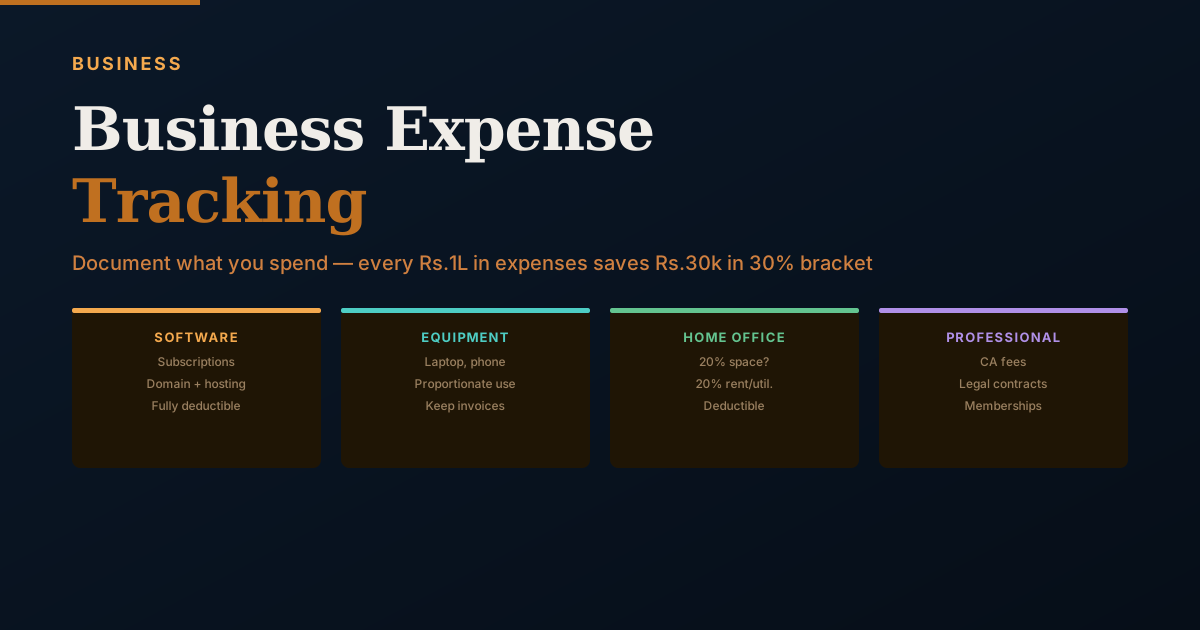
Every legitimate business expense you document reduces your taxable income. For a freelancer in the 30% tax bracket, Rs.1 lakh in documented business expenses saves Rs.30,000 in tax. The expenses need to be real, business-related, and documented.
What Qualifies as a Business Expense
Under the Income Tax Act (Section 37), any expense that is "wholly and exclusively" for business purposes is deductible. This includes:
Direct Business Costs:
- Software subscriptions (design tools, project management, accounting software)
- Domain registration and web hosting
- Online course subscriptions directly relevant to your work
- Professional memberships and associations
- Business books and publications
Communication and Equipment:
- Phone and internet bills (proportionate to business use)
- Laptop, camera, equipment (purchased for business use)
- Printer ink, office supplies
Travel and Transport:
- Client meeting travel (auto, cab, train, air fares for client visits)
- Fuel and vehicle maintenance if vehicle is used for business
- Accommodation for business trips
Office and Workspace:
- Rent for a dedicated workspace or coworking membership
- Utilities proportionate to home office use
- Office furniture and equipment
Professional Services:
- Accountant/CA fees for ITR filing and compliance
- Legal fees for contracts and agreements
- Insurance for professional liability
Marketing:
- Website design and maintenance
- Business cards and marketing materials
- Advertising spend (online or offline for business)
What Doesn't Qualify
- Personal expenses with vague business justification
- Meals and entertainment (has a 50% cap and requires documentation)
- Capital expenditures (land, property — depreciated over time, not fully deducted in year 1)
- Fines and penalties (explicitly disallowed)
The Documentation System
For each expense, keep:
- Receipt or invoice (digital copy is fine)
- Note of business purpose (brief annotation: "Client meeting with [Company], date")
- Payment record (bank statement or credit card statement showing the payment)
A simple folder structure: /Business Expenses/FY2026-27/[Month]/
For recurring subscriptions, keep the subscription confirmation and a monthly screenshot of the charge.
Maintaining an Expense Log
Track expenses in a spreadsheet or accounting software (Zoho Books, Quickbooks, Wave Accounting):
| Date | Description | Category | Amount | Receipt? |
|---|---|---|---|---|
| Apr 5 | Figma annual subscription | Software | 6,000 | Yes |
| Apr 12 | Client meeting cab | Travel | 450 | Yes |
| Apr 15 | Accountant fee | Professional | 15,000 | Yes |
Run the totals monthly — it makes end-of-year ITR preparation much faster.
44ADA Presumptive Taxation
Note on section numbers: the Income-tax Act, 2025 (effective 1 April 2026) consolidated Section 44ADA (and 44AD) into Section 58 — confirmed against the Income Tax Department's official transition FAQ and the Act's own text. The 50% rate and receipt threshold below are unchanged; this page keeps the familiar "44ADA" name since it remains in common use.
For professionals (doctors, engineers, architects, lawyers, IT consultants, etc.) with turnover under Rs.75 lakh: Section 44ADA allows declaring 50% of gross receipts as profit (presumptive basis) without maintaining detailed accounts.
If you use 44ADA, you don't need to document individual expenses — but you also can't claim specific deductions against receipts. It's a simplification trade-off. If your actual expenses exceed 50% of receipts, the regular accounting approach saves more tax.
Equipment Is Usually Depreciated, Not Fully Expensed
A laptop, camera, or phone bought for business isn't typically written off entirely in year one. Under the Income Tax Act's block-of-assets system, capital assets are depreciated at prescribed rates on a written-down-value (WDV) basis:
- Computers, laptops, and software: 40%
- Furniture and fittings: 10%
- Plant and machinery: 15%
- Motor vehicles: 15% (higher in some cases)
So an ₹80,000 laptop gives you ₹32,000 of depreciation in year one (40%), ₹19,200 the next year (40% of the remaining ₹48,000), and so on. Small consumables — cables, ink, stationery — are expensed in full immediately. Under the 44ADA presumptive route, depreciation is deemed already accounted for, so you don't claim it separately.
A Separate Business Account Is Half the Work
The biggest time-saver isn't software — it's a dedicated business bank account and card. When every business rupee flows through one account, your bank statement is most of your expense log, your accountant's work shrinks, and an assessing officer sees a clean, separable trail. Mixing personal and business spending is what turns tax season into archaeology and weakens your position if questioned.
When 44ADA Beats Real Expense Tracking — The Math
44ADA deems 50% of receipts as profit, so it wins whenever your genuine expenses are below 50% of receipts:
- Receipts ₹20L, real expenses ₹4L (20%): 44ADA taxes ₹10L, but you actually profited ₹16L — you legitimately pay tax on less, and skip bookkeeping. 44ADA wins.
- Receipts ₹20L, real expenses ₹12L (60%): real profit is ₹8L, but 44ADA would tax ₹10L. Here, regular accounting with documented expenses wins.
Rule of thumb: low-overhead professionals (consultants, writers, coaches) usually benefit from 44ADA; expense-heavy operations (agencies with staff, gear, ad spend) usually don't.
Know the Audit Threshold
If you don't use presumptive taxation and your turnover crosses the tax-audit limit — ₹1 crore for business (₹10 crore when 95%+ of receipts and payments are digital), or ₹50 lakh for professions — a Section 44AB audit by a CA becomes mandatory. Clean, categorised records all year make that a formality rather than a fire drill.
How TDS Interacts With Expense Tracking
If you hire subcontractors or freelancers and pay them above certain thresholds, you may need to deduct TDS before paying them — even as a sole proprietor, once your business accounts are subject to tax audit.
Section 194J (renumbered Section 393 under the Income-tax Act, 2025, effective 1 April 2026, with the same 10% rate): If you are a company, firm, or individual whose accounts are required to be audited (Section 44AB), you must deduct TDS at 10% when paying professional or technical fees above Rs.50,000/year to any single recipient. That threshold was raised from Rs.30,000 with effect from 1 April 2025, and the Income-tax Act, 2025 carries the same Rs.50,000 figure forward.
Section 194C: TDS at 1% (individual/HUF) or 2% (others) on payments to contractors/sub-contractors for work contracts above Rs.30,000/single payment or Rs.1,00,000/year.
Implication for expense tracking: If you pay a subcontractor Rs.60,000 and are required to deduct TDS, your expense is Rs.60,000 (the full amount) but you pay the subcontractor Rs.54,000 and deposit Rs.6,000 as TDS. Track both components: the full expense (Rs.60,000 as cost) and the TDS liability (Rs.6,000 to be deposited by the 7th of the following month). Issue Form 16A to the subcontractor quarterly.
Most solo freelancers with no employees are not required to deduct TDS on subcontractor payments unless their accounts are subject to audit (turnover above the 44ADA threshold or below but maintaining books and claiming less than 50% profit). Confirm with your CA whether TDS deduction obligations apply to your business.
Expense Tracking Across Multiple Revenue Streams
Many freelancers have diversified income: primary consulting work, occasional training sessions, content creation, or agency-like work where they manage other freelancers. When expenses are shared across revenue streams, the allocation matters for profitability analysis:
Directly attributable expenses: Software subscription bought only for client work on one project = 100% that project. Travel for a specific client meeting = 100% that client.
Shared expenses that benefit multiple projects: Software subscription used across all client work = allocated across all projects by revenue proportion. Internet and phone = business proportion of the overall bill.
Overhead with no direct project attribution: Accountant's fees, professional memberships, generic marketing = allocated to the business overall, not project-specific.
For ITR purposes, the total deductible expense is what matters, not the project-level allocation. But project-level allocation helps you understand profitability per client or service type — which informs pricing decisions.
Digital Receipt Management
The practical challenge of expense tracking is not the accounting — it is capturing receipts consistently. Receipts get lost, automated emails go to spam, physical bills fade. A few approaches that work:
Dedicated email folder: For every business subscription and digital purchase, create a filter that routes receipt emails to a folder labelled "Business Receipts FY26-27." This takes 5 minutes to set up and ensures digital receipts never go missing.
Phone camera for physical receipts: Photograph every physical receipt immediately after receiving it. Store photos in a cloud folder organised by month: Google Drive/Dropbox/iCloud folder structure: /Expenses/FY26-27/May-2026/. A blurry or illegible photo is better than a lost receipt.
Dedicated business credit card: All business expenses on one card — the card statement is itself an expense log. Download the statement monthly and match each entry against your stored receipts.
Accounting software with receipt upload: Zoho Books, Expensify, and others let you photograph a receipt and attach it directly to a transaction. The receipt is permanently linked to the expense record — accessible years later if needed.
The GST Implication of Business Expenses
If you are GST-registered, tracking expenses correctly is not just an income tax matter — it also determines your Input Tax Credit (ITC):
Every business purchase that includes GST (software subscriptions, professional services, equipment, coworking space) generates an ITC that you can offset against your output GST liability. But to claim ITC:
- You must have a valid tax invoice with your GSTIN, the supplier's GSTIN, and proper details
- The purchase must appear in your GSTR-2B (auto-populated based on the supplier's GSTR-1 filing)
- You must have received the goods or services
- You must pay the supplier within 180 days
Practically, this means:
- When buying any business service or product, provide your GSTIN and request a proper GST invoice
- A receipt or acknowledgment without GSTIN details does not generate ITC
- Reconcile your purchase register with GSTR-2B monthly before filing GSTR-3B
For a freelancer with Rs.3-4 lakh in annual business expenses, the ITC at 18% GST is Rs.54,000-72,000 per year. Claiming this ITC systematically versus missing it is a meaningful difference. Sloppy expense tracking directly costs you this money.
End-of-Year Expense Review
Before your CA files your ITR, conduct a structured expense review:
Step 1: Run a total of all business expenses by category from your expense log.
Step 2: Remove any expenses that were personal or mixed-use (use only the business proportion).
Step 3: Verify that equipment purchases are identified separately and will be handled through depreciation (not as current year expenses under 44ADA — under presumptive taxation, depreciation is deemed taken; under regular accounting, compute WDV depreciation).
Step 4: Flag any single large expense (above Rs.20,000-50,000) and confirm it qualifies as a deductible business expense versus a capital expenditure that should be depreciated.
Step 5: Ensure all professional service invoices (CA fees, legal fees) are in-hand as documentation.
Step 6: If GST-registered, confirm your ITC claimed in GSTR-3B matches the expenses in your purchase register.
This review takes 1-2 hours done once a year if your records are current. It consistently surfaces legitimate deductions that might have been missed, reduces year-end surprises, and gives your CA the clean data they need to file accurately.
Categorising Expenses for Your CA: The Handoff That Saves Money
Most CA fees are proportional to the time they spend organising your records. If you hand over a well-organised expense log, your CA spends 2 hours on your ITR. If you hand over a pile of bank statements and loose receipts, they spend 8 hours — and charge accordingly. The expense tracking discipline pays for itself in reduced professional fees before the income-tax saving is even counted.
What a CA needs from you at year-end, by category:
Category 1 — Fully deductible direct expenses: Software subscriptions, professional memberships, domain/hosting, client meeting travel, coworking rent, professional development courses. List each with: date, amount, supplier, business purpose, and whether GST was charged (which determines whether ITC is claimable).
Category 2 — Proportionate expenses (home office, phone, internet): State the proportion you've used for business and provide the full bills. Your CA will apply the agreed proportion. Keep the underlying bills — not just your calculated proportion.
Category 3 — Capital assets bought during the year: List each item separately with purchase date, amount, and invoice. Your CA will compute WDV depreciation. Do not include these in your "direct expense" total — mixing current expenses and capital expenditure is the most common bookkeeping error freelancers make.
Category 4 — Professional services paid: CA fees, lawyer fees, subcontractor payments. If you paid a subcontractor above ₹50,000 and were required to deduct TDS (Section 194J), note whether TDS was deducted and deposited. This affects both your expense claim and your CA's liability assessment.
Category 5 — GST on expenses: Separately note the ITC you've claimed in GSTR-3B for the year on business purchases. Your CA uses this to reconcile ITC on the GST return with expenses in the income tax accounts.
A simple spreadsheet with these five categories, one row per expense, takes 15–20 minutes per month to maintain. The alternative — reconstructing a year's records in March — takes a weekend and is error-prone.
Expenses That Survive a Tax Scrutiny Notice
If the IT department scrutinises your return (increasingly likely as GST and banking data cross-references improve), the test for each deducted expense is straightforward: can you demonstrate that it was wholly and exclusively for business, supported by a real document?
Expenses that pass scrutiny: Invoices from GST-registered suppliers with your GSTIN, card or bank transfer payment records, clear business purpose notation, and matching ITC entry in GSTR-2B.
Expenses at risk: Cash payments without receipts, personal-looking purchases with vague business justification, annual subscriptions to consumer services (Netflix claimed as "client entertainment"), or equipment with no business use evidence.
The threshold rule: Any single expense above ₹50,000 will be examined closely if your overall expenses are reviewed. Keep original invoices (not just screenshots) for large items.
Whether a specific expense qualifies as deductible is a facts-and-circumstances question — for anything borderline or high-value, get your CA's view before claiming it.
Frequently Asked Questions
Sources and references
- Goods and Services Tax — Official GST Portal, Government of India
- Income Tax Department, Government of India
- Income Tax Department — Income-tax Act, 2025 (FAQs on Interplay and Transition, and Act text)
Rules, rates, and thresholds in India change over time. Always confirm the current position with the official source above before acting on it.