Balance Transfer Credit Cards: When They Help and When They Don't
A balance transfer moves high-interest debt to a lower-rate card. It works — if you understand the fees, the window, and what it demands of your behaviour.
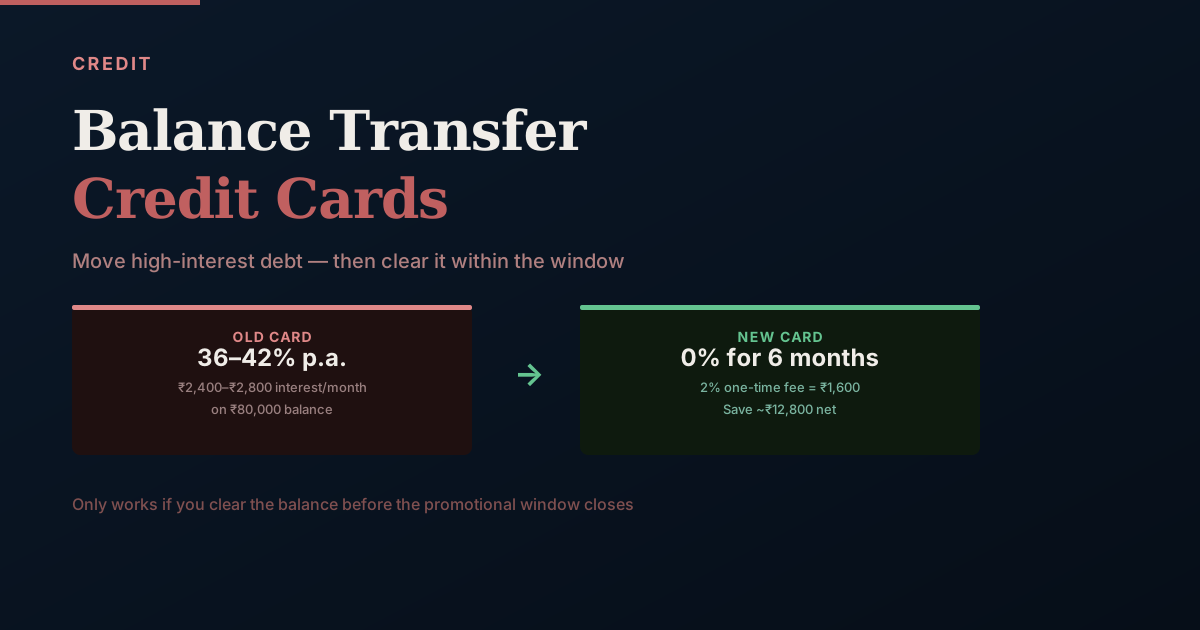
When you're carrying a credit card balance at 36–42% annual interest, a balance transfer to a lower-rate card can save significant money. The execution requires discipline, and the math needs to work out first.
Before you commit, run the offer through the balance transfer calculator — it nets the transfer fee against the interest you would save, so you can see whether a specific deal is actually worth taking.
What a Balance Transfer Is
A balance transfer moves your existing credit card debt (or sometimes a personal loan) to a new credit card at a lower promotional interest rate — often 0% or 1–2% per month for a defined period (typically 3–12 months).
After the promotional period, the standard rate applies to any remaining balance.
When a Balance Transfer Makes Sense
Use it when:
- You have high-interest credit card debt you cannot clear immediately
- The new card's promotional rate + fee results in meaningful savings vs current interest
- You have a realistic plan to clear (or significantly reduce) the balance within the promotional window
- You will not accumulate new spending on the old or new card during the transfer period
The Math: Does It Actually Save Money?
Example calculation:
- Current debt: ₹80,000 on a card at 36% p.a. (3% per month)
- Monthly interest: ₹2,400
- Transfer offer: 0% for 6 months, 2% transfer fee
Transfer fee: ₹80,000 × 2% = ₹1,600
Interest saved in 6 months at old rate: ₹2,400 × 6 = ₹14,400 (approximate — it would reduce as you pay down the balance, but the savings are still substantial)
Net saving: ₹14,400 – ₹1,600 = ₹12,800 in 6 months, assuming you clear the balance
This is a good deal — if you stick to the plan.
The Traps That Make Balance Transfers Fail
Not paying enough each month: To clear ₹80,000 + ₹1,600 fee in 6 months requires ₹13,600/month. If your monthly payments are ₹5,000, you'll have ₹51,600 remaining when the standard rate kicks in.
Continuing to spend on the old card: The whole point is to stop adding to high-interest debt. If you use the old card while paying off the transfer, you're back where you started.
Spending on the new card: Many people use the new card for daily spending while the balance sits there. New transactions on the card accumulate at the full standard rate, and minimum payments often go toward the promotional balance first, leaving new spend to accrue interest.
Not reading the fine print: Some banks apply payments to the promotional balance last, meaning new transactions on the same card accrue interest at full rate immediately. Understand exactly how payments are applied.
How to Execute a Balance Transfer Correctly
- Calculate net savings first — transfer fee vs total interest saved over the promotional window
- Set up an automated payment for the amount needed to clear the balance within the window
- Freeze the old card — don't use it after the transfer
- Don't spend on the new card beyond what you can clear immediately
- Calendar the end date — know exactly when the promotional period expires
- Have a contingency plan — if you can't clear it fully, make sure the remaining balance will be at a better rate than your starting point
Balance Transfer vs Personal Loan
For larger amounts or longer payoff windows, a personal loan at 12–15% might be more appropriate than a balance transfer:
| Feature | Balance Transfer | Personal Loan |
|---|---|---|
| Promotional rate | 0–6% for 3–12 months | Fixed 12–18% throughout |
| After promotional period | Reverts to 36–42% | Consistent rate |
| Appropriate if | Can clear in window | Need 12–36 months |
| Documentation needed | Minimal | Income proof, credit check |
For debt that takes 2+ years to clear, a personal loan's predictable rate often wins over a balance transfer's revert risk.
Which Indian Banks Offer Balance Transfer Facilities?
Most major Indian banks and card issuers offer some version of balance transfer on credit cards, though terms vary significantly and change with promotional cycles.
HDFC Bank: Offers "Balance Transfer on EMI" — outstanding balance from other bank cards can be transferred and converted to 3, 6, 9, 12, 18, or 24 month EMIs at interest rates that have ranged from 0.99% to 1.5% per month depending on tenure and promotion. Processing fee typically 1–2%.
SBI Cards: "Easy Money" and "Balance Transfer" facilities on SBI credit cards convert outstanding to lower-rate EMIs. Rates vary from 1.07% to 1.67% per month. SBI being a large issuer, it frequently runs promotional balance transfer campaigns for new and existing cardholders.
Axis Bank: Offers balance transfer to Axis credit cards from other issuers. Rate structures are similar — promotional rates for defined windows. Processing fee of 1–2% is standard.
ICICI Bank: Provides balance transfer facility for ICICI cardholders to consolidate balances from other cards. Terms are card-specific and change by campaign cycle.
Note: Balance transfer offers are promotional and change frequently. Always check the current offer directly with the bank before assuming a particular rate is available. The rates mentioned above are illustrative — actual offers at the time of your inquiry may differ.
The Step-by-Step Execution Process
When you have identified a genuine balance transfer opportunity, the process typically works as follows:
Step 1: Check current offers on your card issuer's portal. Log into netbanking or the mobile app for the card you intend to transfer to. Look for "Balance Transfer" or "BT Offer" sections. Alternatively, call the bank's credit card helpline.
Step 2: Confirm the details in writing. Before initiating, get clear written (or in-app) confirmation of: transfer rate, promotional period end date, processing fee, how payments will be applied (to BT balance or new spend first), and the rate that kicks in after the promotion.
Step 3: Initiate the transfer request. Most banks process this within 5–7 business days. The funds are either credited to the old card issuer directly, or in some cases, credited as a statement credit on your existing card and you pay the old card yourself.
Step 4: Verify the transfer on both sides. Check that the old card's outstanding is now zero (or at the reduced level if it was a partial transfer). Also confirm the balance transfer amount now appears on the new card.
Step 5: Set up automated payments. Calculate: (transferred amount + fee) ÷ promotional months = required monthly payment. Set this as an auto-debit from your bank account on the payment due date.
Step 6: Freeze the old card. Do not use the old card for new purchases during the repayment period. If the old card issuer attempts to keep you as a customer by offering spending rewards, the risk of reaccumulating debt outweighs any benefit.
Balance Transfer and Your CIBIL Score
Balance transfers affect your CIBIL score in several ways that are worth understanding:
Applying for a new card: If the balance transfer involves applying for a new card (rather than using an existing one), there is a hard inquiry on your report. This temporarily reduces the score by 5–10 points.
Opening a new account: A new credit card account reduces the average age of your credit accounts — a mild negative short-term impact.
Utilisation on the new card: After the transfer, the new card immediately shows a high utilisation (you've transferred a large balance onto it). This can reduce your score temporarily. As you pay it down over the promotional period, utilisation decreases and the score benefits.
Closing the old card: Many people want to close the old card after transferring the balance off it. Consider first: if it is an old card with good history, keeping it open (at ₹0 balance) maintains your available credit limit and credit history age. Closing it reduces total available credit, which can push up utilisation on remaining cards.
The net credit score impact of a well-executed balance transfer — where you pay down the transferred balance and keep the old card open — is typically neutral to mildly positive over 12 months.
Common Balance Transfer Mistakes in India
Applying during a credit score dip: If your score has recently dropped (due to a missed payment or high utilisation), you may not qualify for the promotional rate or may be offered a less favourable one. Time the application for when your score is strongest.
Forgetting the promotional end date: Set a calendar reminder 30 days before the promotional period ends. This gives you time to either pay off the remaining balance or refinance into a personal loan if needed, rather than discovering the revert rate has kicked in after missing the deadline.
Not reading the payment hierarchy clause: Some cards apply monthly payments to the lowest-interest balance first — meaning your regular spending (at standard 36%+ rates) may accrue interest while the promotional BT balance gets paid down. Always check how your payments are applied.
Partial transfers that don't solve the problem: Transferring ₹60,000 out of ₹80,000 outstanding on the old card and leaving ₹20,000 behind at 36% doesn't fully stop the bleeding. If doing a partial transfer, have a separate plan for the remaining balance.
Using a balance transfer to delay rather than solve: A balance transfer is a tool to reduce interest cost while you pay down the debt. It only works if the debt actually decreases. Using it as a way to buy time without changing spending behaviour means you'll face the same (or larger) debt when the promotional period ends.
When to Escalate to a Personal Loan Instead
The personal loan route is better than a balance transfer in these scenarios:
- Your total outstanding credit card debt exceeds ₹2 lakh and will take more than 12 months to clear
- You cannot find a promotional balance transfer offer with a window long enough for your realistic repayment
- The combined balance transfer fee + interest during the promotional period exceeds what a 12–14% personal loan would cost for the same amount and period
- Your credit score is strong enough (750+) to qualify for a good personal loan rate — this matters because personal loans at 10–13% are available to strong credit profiles
A personal loan at 14% for 24 months on ₹1.5 lakh outstanding credit card debt:
- Total interest: approximately ₹22,000
- Monthly EMI: ₹7,200
A balance transfer at 0% for 6 months with 2% fee + revert to 36% for the remaining 18 months (if only ₹30,000 remaining at month 6):
- Total cost significantly higher if you don't clear the balance in the promotional window
The personal loan wins on predictability and total cost for larger amounts over longer windows. The balance transfer wins for amounts you can realistically clear in 3–6 months.
Using a Balance Transfer to Improve Your CIBIL Score Trajectory
A well-executed balance transfer has a secondary benefit beyond interest savings: it can improve your CIBIL score trajectory more quickly than minimum payments alone.
When you carry a ₹80,000 balance on a card with a ₹1 lakh limit, your utilisation on that card is 80% — a significant score suppressant. Transferring this balance to a new card with a ₹1.5 lakh limit and then paying down ₹13,000+ per month during the promotional window does two things simultaneously:
- Reduces the new card's utilisation as you pay down the transferred balance
- Drops the old card's utilisation to zero, assuming you stop using it
If the old card has a ₹1 lakh limit and now shows a zero balance, your total available credit includes that ₹1 lakh at zero utilisation. The new card's utilisation drops as you pay down the transferred balance. By month 4–5 of the promotional window, your aggregate utilisation may have dropped from 70%+ to under 30% — a material score improvement.
This assumes you do not use the old card for new spending during the period. It is one of the few scenarios where a balance transfer creates a dual benefit: cheaper debt service AND better utilisation profile simultaneously.
Tax Treatment: Is Balance Transfer Interest Deductible?
For credit card interest and balance transfer costs, there is no tax deduction available under Indian income tax rules for individuals using credit cards for personal expenses. This contrasts with home loan interest (Section 24b deduction) and some business loan interest (claimable as business expense in ITR).
However, if you are a self-employed professional or business owner who uses a credit card for legitimate business expenses, and the balance being transferred relates to those business expenses, the interest may be claimable as a business expense under Section 37 of the Income Tax Act. This requires clear documentation linking the credit card usage to business purposes and should be evaluated with a qualified CA.
For salaried individuals using credit cards for personal expenses, the balance transfer fee and interest during or after the promotional period are purely personal costs with no tax deduction benefit.
Frequently Asked Questions
Sources and references
Rules, rates, and thresholds in India change over time. Always confirm the current position with the official source above before acting on it.