Advance Tax for Self-Employed: How to Calculate and Pay on Time
Self-employed, freelancing, or running a business? Advance tax is mandatory and missing deadlines costs interest. Here's how to calculate and pay it.
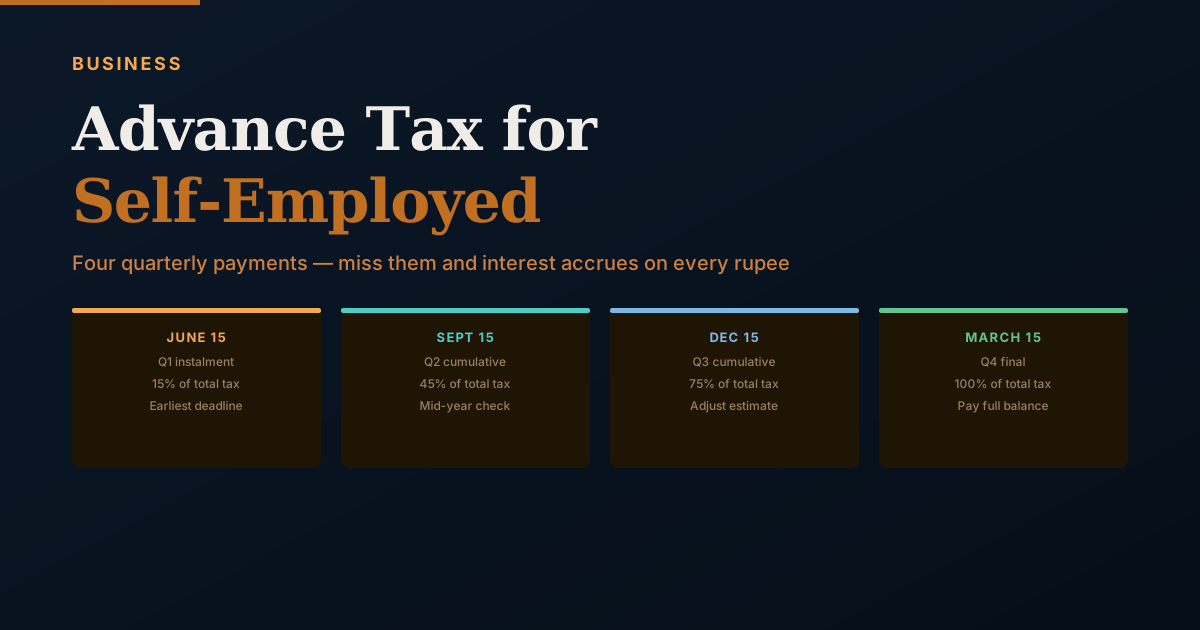
Advance tax is income tax paid in instalments during the year, rather than as a lump sum at filing time. For self-employed professionals, freelancers, and business owners, it's mandatory if your tax liability is Rs.10,000 or more for the year.
Why Advance Tax Exists
The government uses a "pay as you earn" principle. Salaried employees do this through TDS. Self-employed and business owners do it through advance tax. It maintains government cash flow and prevents a massive year-end spike in tax collection.
Who Needs to Pay Advance Tax
- Freelancers and independent professionals
- Business owners (sole proprietors, partners in firms)
- Anyone with significant non-salary income: rental income, capital gains, interest income
- Salaried employees whose non-salary income carries a tax of Rs.10,000 or more
The Four Quarterly Deadlines
| Instalment | Deadline | Minimum % of Total Tax Due |
|---|---|---|
| Q1 | June 15 | 15% |
| Q2 | September 15 | 45% (cumulative) |
| Q3 | December 15 | 75% (cumulative) |
| Q4 | March 15 | 100% |
How to Calculate Advance Tax
Step 1: Estimate total income for the year Income from all sources: professional fees, business income, rent, interest, capital gains
Step 2: Calculate gross tax liability Apply tax slabs to total income (under old or new regime, whichever you choose)
Step 3: Subtract TDS already deducted Any TDS deducted by clients (Form 16A) or banks (on FDs) reduces your advance tax obligation
Step 4: Check if the balance is Rs.10,000 or more If (total tax - TDS) is Rs.10,000 or more, advance tax is applicable. Section 404 of the Income-tax Act, 2025 sets the trigger at "Rs.10,000 or more", not above Rs.10,000 — a balance of exactly Rs.10,000 is already caught.
Step 5: Pay quarterly instalments Pay 15% by June 15, 45% total by September 15, 75% total by December 15, 100% by March 15
How to Pay Advance Tax
Payment is made online through the Income Tax e-filing portal:
- Go to incometax.gov.in
- Select e-Pay Tax
- Pick the Act first. e-Pay Tax now opens by asking which Act your payment falls under: Income Tax Act 1961 covers assessment year 2026-27 and earlier (income up to FY 2025-26), and Income Tax Act 2025 covers tax year 2026-27 onwards
- Choose Challan 280 (Income Tax)
- Select "Advance Tax (100)" and the period. There is no assessment year under the 2025 Act — the department's own challan guide says challans under the old Act were filed on the assessment year, while under the new one they must be filed on the tax year, which is simply the year you earned the money. So for FY 2026-27 income you select Tax Year 2026-27. AY 2027-28 is not on offer, and picking the wrong period credits the payment to the wrong year, which shows up as a mismatch when you file
- Enter amount and complete payment via net banking or debit card
- Save the challan receipt — it's your proof of payment
44ADA Users: Simplified Calculation
If you use the presumptive taxation scheme (Section 44ADA), your professional income is deemed to be 50% of gross receipts. This forms the basis for advance tax calculation — you don't need to itemise expenses. (Note: the Income-tax Act, 2025, effective 1 April 2026, consolidated 44ADA and 44AD into Section 58 — same 50%/8%/6% rates and thresholds, per the Income Tax Department's official transition FAQ. This page keeps the familiar 1961-Act names since they remain in common use.)
Example: Gross professional receipts for FY = Rs.40 lakh Presumptive income under 44ADA = Rs.20 lakh Tax on Rs.20 lakh (old regime, after basic exemption and deductions): approximately Rs.4-5 lakh depending on other deductions Advance tax = above amount, minus TDS already deducted
44ADA/44AD Users Get One Deadline, Not Four
Here's a major simplification most freelancers miss: if you opt for presumptive taxation under Section 44ADA (professionals) or 44AD (small businesses), you can pay your entire advance tax in a single instalment by March 15, instead of the four-quarter schedule above — and you're not charged 234C interest for skipping the June, September, and December instalments. One estimate, one payment, once a year.
What Missing a Deadline Actually Costs
The interest is modest but real. Say your total tax is ₹2,00,000 and you pay nothing until you file in July:
- 234B: about 1% per month on the unpaid tax from April until you pay — roughly ₹8,000 over four months.
- 234C: about 1% per month on each quarter's shortfall — another few thousand.
It's not ruinous, but it's pure dead money for missing dates you knew in advance.
The June and September tolerance
One relief is worth knowing before you panic about a small miss. Section 425(2) of the Income-tax Act, 2025 — carried over from the first proviso to Section 234C of the 1961 Act — charges no 234C interest for the June instalment if you have paid at least 12% of the year's tax by 15 June, and none for the September instalment if you have paid at least 36% by 15 September. The scheduled targets stay 15% and 45%; the tolerance just means being slightly short on those two dates costs nothing.
There is no equivalent cushion for December (75%) or March (100%). Miss either of those by a rupee and interest runs on the whole shortfall for that quarter. In practice: aim at the table above, but if cash flow is tight early in the year, know that 12% by June and 36% by September keep you clean, and save the precision for the last two instalments.
Reconcile TDS Before You Compute
Before each instalment, check your Form 26AS and Annual Information Statement (AIS) on the income-tax portal. Clients who deduct TDS — typically 10% under Section 194J on professional fees (renumbered Section 393 under the Income-tax Act, 2025, effective 1 April 2026; same 10% rate) — report it there. Subtract that credited TDS from your estimate, or you'll overpay. Catch any mismatch (a client deducted but didn't deposit) early, so you can chase it before filing.
The Habit That Removes the Pain
Advance tax hurts because it lands as a lump sum on dates you forgot. Fix it the way salaried TDS works: the day each client payment arrives, move 25–30% into a separate tax account. By each deadline the money is already there — you're transferring from your own buffer, not scrambling. This one habit turns advance tax from a quarterly shock into a non-event.
Advance Tax Calculation Worked Example
A freelance management consultant in Bengaluru, FY 2026-27:
- Projected gross receipts: Rs.36 lakh
- Opts for 44ADA (presumptive): taxable income = Rs.18 lakh
- Has no other income except Rs.80,000 in bank FD interest
- Total taxable income: Rs.18,80,000
- Tax under new regime (FY 2026-27 slabs, which Budget 2026 left untouched): Rs.1,76,000 plus 4% cess of Rs.7,040 = Rs.1,83,040
- TDS expected from clients (10% on Rs.36L): Rs.3,60,000 — this exceeds total tax liability
In this case, total advance tax liability = Rs.0 after netting the expected TDS. No advance tax payments are needed.
Now a second consultant on the same Rs.36 lakh of receipts, paid entirely by individuals and small businesses that don't deduct TDS — and with no other income at all:
- Projected gross receipts: Rs.36 lakh, no TDS deducted by any client
- Taxable income (44ADA): Rs.18 lakh, and nothing else
- Tax under the new regime, slab by slab: nil on the first Rs.4 lakh; 5% on the next Rs.4 lakh = Rs.20,000; 10% on the next Rs.4 lakh = Rs.40,000; 15% on the next Rs.4 lakh = Rs.60,000; 20% on the remaining Rs.2 lakh = Rs.40,000. Total Rs.1,60,000, plus 4% cess of Rs.6,400 = Rs.1,66,400
- That is far past the Rs.10,000 trigger, so advance tax is mandatory
- Under 44ADA: single instalment of Rs.1,66,400 by March 15
The gap between the two consultants — Rs.1,83,040 against Rs.1,66,400 — is exactly Rs.16,640, which is the tax and cess on the first one's Rs.80,000 of FD interest. That interest sits wholly inside the 20% band, because her professional income has already used up everything below it. Interest income is never too small to matter for advance tax: it stacks on top of the rest at your highest rate.
Situations Where Advance Tax Gets Complex
Multiple income sources: If you have professional income plus capital gains from equity mutual funds, the capital gains must be included in the advance tax calculation. Short-term capital gains (STCG) on equity are taxed at 20%; long-term capital gains above Rs.1.25 lakh at 12.5%. Budget 2024 set these rates, and they continue unchanged for FY 2026-27. They have their own tax rates that stack on top of your regular income tax.
Rental income: If you receive rental income, it's included in total income for advance tax. TDS on rent (Section 194I or 194IB) may partially offset this, but only if your tenant deducts TDS — individuals paying rent below Rs.50,000/month have no TDS obligation.
Capital gains on property sales: If you sell property during the year, capital gains must be estimated and included in advance tax. For short-term capital gains on property (held under 2 years), the full gain is taxable at slab rates. Consult a CA immediately if you sell property, as the advance tax implications can be significant and the March 15 deadline doesn't wait.
Agricultural income over Rs.5,000: Agricultural income is partially exempt but still affects the rate at which other income is taxed. The partial integration rules mean you need to compute tax correctly.
Advance Tax Under Old vs New Regime
The choice of tax regime affects your advance tax calculation. Once you choose the old or new regime for the year (this choice is made when you file ITR, but you should estimate from the start), all quarterly calculations must use that regime consistently.
Old regime advantages: Allows deductions under 80C (up to Rs.1.5 lakh), 80D (health insurance), HRA, LTA, home loan interest, and others. It wins only when you have a genuinely large stack of these to claim — and since the Budget 2025 slabs (retained for FY 2026-27) that stack has to be larger than it used to be.
New regime advantages: Wider slabs, no deduction tracking required, and it is the default regime. Under the FY 2026-27 slabs, tax is nil up to Rs.12 lakh of taxable income thanks to the Section 87A rebate of Rs.60,000. The Rs.75,000 standard deduction is a salary deduction, so a pure freelancer on 44ADA doesn't get it — the nil-tax point for you is Rs.12 lakh, not the Rs.12.75 lakh a salaried reader will have seen quoted.
For advance tax quarterly estimates, calculate both scenarios in April-May of the year, choose the regime that results in lower tax, and use that for all four quarterly payments. Do not switch regimes mid-year in your estimates — it makes reconciliation at filing time needlessly complicated.
What Happens When You Overpay Advance Tax
Overpaying advance tax is not a problem. The excess sits as a credit against your tax liability and becomes a refund when you file your ITR.
Refunds are processed by the Income Tax department after ITR verification (e-verification within 30 days of filing). Most refunds for individuals are processed within 3-6 weeks of ITR processing, credited directly to the bank account linked to your PAN.
Overpaying is preferable to underpaying because:
- You earn a small government interest rate on refunds (currently 6% per annum under Section 244A) if the refund exceeds 10% of tax due
- There is no penalty for overpaying
- Underpaying triggers 234B/234C interest
Common Mistakes in Advance Tax
Calculating on net income received, not gross: Income includes all professional fees regardless of TDS deduction. If a client paid you Rs.90,000 after deducting Rs.10,000 TDS, your income is Rs.1,00,000. Your tax is computed on Rs.1,00,000, not Rs.90,000.
Forgetting non-client income: Interest from savings accounts (above Rs.10,000), FD interest, rental income, capital gains — all taxable income counts for advance tax. Bank FD interest is fully taxable (unlike savings bank interest, which has a partial exemption under 80TTA up to Rs.10,000 — but only if you are on the old regime; the new regime allows neither). Note too that TDS on bank interest only kicks in above Rs.50,000 a year per bank (Rs.1 lakh for senior citizens) — below that the income is still fully taxable, it just arrives with no TDS credit attached to soften your advance tax.
Not checking 26AS before each instalment: Before paying each quarter, verify what TDS has already been deposited by clients in Form 26AS. Subtract confirmed TDS credits from your total advance tax liability. Don't pay advance tax on income for which TDS has already been deposited — you'll just create an overpayment.
Misidentifying as 44ADA when not eligible: Section 44ADA applies to specified professions — doctors, lawyers, engineers, architects, accountants, technical consultants, management consultants, interior decorators, and a few others. Freelancers whose work doesn't fall under a specified profession (photographers, content creators, graphic designers, social media managers) typically use Section 44AD (business income), which has a different presumptive rate (6% of turnover for digital/bank receipts, 8% for cash). If neither applies, regular accounting and ITR-3 is required.
The Self-Assessment Tax Step
After filing ITR, if any tax remains due beyond advance tax paid and TDS credited, the balance is paid as Self-Assessment Tax (SAT) — using the same Challan 280, selecting "Self-Assessment Tax (300)" instead of "Advance Tax (100)." This must be paid before filing the ITR, as the ITR requires entering the challan details.
If you've been regular with advance tax throughout the year, the SAT amount is typically small — just the true-up after actual figures are known versus estimates used for advance tax.
Using the AIS to Catch Income You May Have Missed
The Annual Information Statement (AIS) on the income-tax portal is more comprehensive than Form 26AS. It aggregates information from multiple sources: banks (interest, dividends), brokers (mutual fund transactions, equity sales), registrars (property transactions), and any other party that files returns mentioning your PAN.
Before each quarterly advance tax instalment, log in to incometax.gov.in, navigate to Services → Annual Information Statement, and review the draft AIS for the year-to-date. Look specifically for:
- Interest from fixed deposits: Banks report this to the IT department. If you've earned ₹80,000 across several FD accounts and only noticed the TDS certificate from one bank, the AIS will show all of them.
- Dividend income: Now fully taxable in the hands of the recipient. Dividend payouts from shares and mutual funds appear in AIS. If you haven't factored them into your advance tax estimate, you may be underpaying.
- Capital gains from mutual funds: Groww, Zerodha, and other platforms report redemption data. Long-term capital gains above ₹1.25 lakh and all short-term capital gains must be included in your advance tax estimate.
- Rental income: If your tenant is a company or firm, it deducts TDS under Section 194I once the rent it pays you crosses ₹6 lakh a year (₹50,000 a month). An individual or HUF tenant not under tax audit deducts under Section 194IB instead, at 2%, above the same ₹50,000-a-month mark. Check whether either appears in AIS.
The AIS allows you to "accept" or "dispute" the entries. Dispute inaccurate entries early — a disputed entry that you don't respond to eventually becomes an IT department query.
A Simple Quarterly Advance Tax Checklist
Use this before every instalment deadline:
| Step | Action |
|---|---|
| 1 | Log in to incometax.gov.in, check AIS for any new income entries |
| 2 | Update your YTD income estimate (professional fees + all other income) |
| 3 | Choose old or new regime — apply consistent slab rates |
| 4 | Deduct 80C, 80D and other applicable deductions (old regime only) |
| 5 | Calculate gross tax on estimated annual income |
| 6 | Subtract TDS credited in Form 26AS for the current year |
| 7 | Subtract advance tax already paid in earlier instalments |
| 8 | Pay the required instalment % minus what's already paid |
| 9 | Save Challan 280 receipt in your tax folder |
| 10 | Set a calendar reminder for the next deadline |
Doing this exercise takes 30–45 minutes each quarter. The alternative — a surprise tax demand at ITR filing — takes significantly longer and costs you interest under 234B and 234C.
Frequently Asked Questions
Sources and references
- Income Tax Department, Government of India
- Income Tax Department — Income-tax Act, 2025 (FAQs on Interplay and Transition, and Act text)
- Income Tax Department — Tax Payments (e-Pay Tax) help
- Income Tax Department — Challan Creation through PAN Login (Act selection and Tax Year)
- Income-tax Act, 2025 (Act 30 of 2025) — Gazette of India, section 404 (₹10,000 or more) and section 425(2) (12% / 36% tolerance)
Rules, rates, and thresholds in India change over time. Always confirm the current position with the official source above before acting on it.